


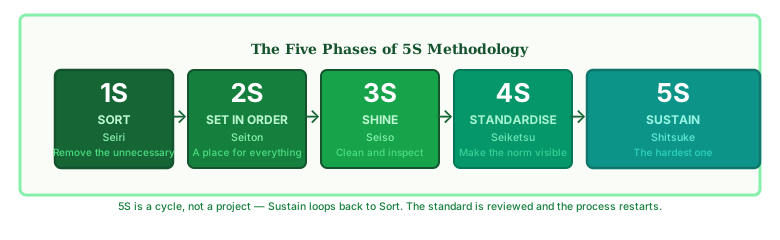
Most teams get through the first three 5S methodology steps without much difficulty. Sort, Set in Order, Shine — these are physical activities. You can see the progress. You can photograph the before and after. You can show the results to management. The fourth and fifth phases — Standardise and Sustain — are where organisations stall. Sustain in particular is where most 5S programmes eventually collapse, usually within six to eighteen months of the initial launch, because sustaining a clean and organised workspace requires a change in daily behaviour, not a one-time effort. This article covers how each phase works and what actually makes the difference between a 5S programme that holds and one that doesn’t.
Table of Contents
What is 5s Methodology?
What Is 5S Methodology? The Steps and What Each One Does
The 5S methodology steps form a workplace organisation system: Sort out what doesn’t belong, give everything else a defined location, clean and inspect regularly, standardise those practices, then sustain them. The five Japanese words behind it — Seiri, Seiton, Seiso, Seiketsu, Shitsuke — each start with S, which is how it got its name. Toyota developed the formal system. The underlying logic predates Toyota by decades — Henry Ford’s CANDO (Cleaning, Arranging, Neatness, Discipline, Ongoing improvement) covered similar ground before World War II.
The concept predates its formalisation in Japan. Understanding the 5S methodology steps — what each one requires and why the sequence matters — is the starting point for any implementation. Organising workplaces, removing unnecessary items, and cleaning equipment are not novel ideas. What 5S adds is a structured sequence and — critically — the fifth phase that attempts to make the improvements permanent. Without Shitsuke, the other four phases produce a tidy workspace that gradually returns to its previous state. With it, they produce a changed way of working. The difference between those two outcomes is almost entirely cultural rather than technical.
5S Step 1: Sort (Seiri) — Remove What Doesn’t Belong
The first phase asks a single question about every item in the workspace: is this needed here? Not “is this useful?” Not “might we need this someday?” Specifically: is this item needed in this workspace, by this team, in the next defined period? If the answer is no, it leaves.
The mechanism for sorting is the red tag. Items that are questionable — not clearly needed but not obviously waste — get a red tag and move to a designated holding area. The holding area has a deadline: items not claimed within a fixed period (typically 30 days) are disposed of, relocated, or returned to stores. The red tag process avoids the argument about whether something might be useful. It creates a defined process for making that decision rather than leaving it to individual judgement in the moment.
The most common resistance to Sort comes from people who’ve worked in a space for years and have accumulated items that feel necessary. The test is always the same: when did you last use this? When will you next use it? If neither question has a concrete answer, the item belongs in the red tag area, not on the workbench. Accumulation isn’t neutral — it consumes space, creates visual noise that makes real problems harder to see, and introduces the possibility of using the wrong item at the wrong time.
Sort is also where safety hazards surface. A manufacturing floor that’s been accumulating clutter for years often contains unlabelled containers, expired materials, equipment taken out of service but never formally removed, and consumables stored in the wrong location. A 5S Sort event frequently finds things that facilities management had no record of. On one programme I was involved with — a food processing site — the Sort phase uncovered a pallet of cleaning chemical that had been sitting behind a racking unit for what the label suggested was about four years. Nobody knew it was there. The site had passed two external audits in that period.
5S Step 2: Set in Order (Seiton) — A Place for Everything
Set in Order assigns a specific location to every item that survived Sort. The goal is that anyone — including someone who doesn’t normally work in this space — can find what they need within 30 seconds and return it to the right place without having to think about where it goes.
The tools for Set in Order are visual: shadow boards that show exactly where each tool belongs, floor markings that define equipment zones, labelled storage locations for consumables, colour coding that communicates function or ownership. The principle behind all of them is the same — the correct location should be obvious from looking at it, not from knowing where something has always been kept.
Frequency of use should drive proximity. Items used every hour belong within arm’s reach. Items used once a week can be stored further away. Items used monthly can be in a separate storage area. This sounds obvious, but in practice most workspaces have accumulated random storage arrangements that reflect how things arrived rather than how they’re used. A Set in Order exercise frequently reveals that the tools a team uses constantly are stored at the far end of the workspace because that’s where there was space for them when they were first introduced.
Set in Order is also where the investment in visual management shows its return. A tool missing from its shadow board is immediately visible — the shape is still there, the item is not. No inventory system required. No manual check. The absence shows itself. This is one of the reasons 5S produces measurable reductions in time spent searching for tools and equipment: the system makes abnormalities visible in real time.
5S Step 3: Shine (Seiso) — Clean and Inspect
Shine means cleaning the workspace thoroughly and establishing cleaning as a regular, scheduled activity. Not a periodic deep clean when things get bad enough. A routine that happens daily or by shift, that has defined owners and defined standards.
The insight behind Seiso that distinguishes it from routine housekeeping: cleaning is inspection. When you clean a machine properly — wiping down surfaces, checking fluid levels, clearing swarf from moving parts — you encounter the early signs of problems that a visual inspection from a distance would miss. A small oil leak. An unusual wear pattern. A fastener that’s working loose. Cleaning as inspection is the foundation of autonomous maintenance in TPM (Total Productive Maintenance), and 5S Shine is where the habit starts.
Cleaning standards need to be specific enough to be auditable. “Keep the area clean” is not a standard. “Wipe down the machine surfaces at the end of each shift, check fluid levels, clear the floor of all swarf, and sign the cleaning sheet” is a standard. The difference is that the second version can be checked, trained, and sustained. The first version depends entirely on each person’s individual interpretation of clean.
5S Step 4: Standardise (Seiketsu) — Make the Normal Visible
Standardise is the phase that converts the first three Ss from a one-time event into a system. It creates the documented standards, audit processes, and visual controls that make the current state visible and the expected state clear.
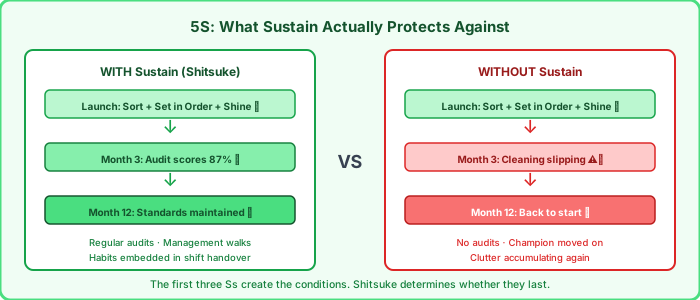
Without Standardise, Sort, Set in Order, and Shine produce a tidy workspace that gradually reverts. Things accumulate again. The cleaning schedule slips. Tools end up back where they were before. Standardise prevents reversion by making the standard visible — photos of what the area should look like, cleaning schedules posted at the point of use, audit checklists that are completed regularly and reviewed by supervisors.
What the 5S Standardise Step Looks Like in Practice
A standardised 5S area typically has: a visual standard (photograph showing the correct state of the area), a cleaning and inspection schedule posted at the location with responsibility clearly assigned, a simple audit checklist used weekly or monthly to confirm the standard is being maintained, and a process for raising deviations — a way to flag when something is wrong that doesn’t require going up two levels of management to report a missing tool.
The audit is not about catching people out. A 5S audit that’s used punitively — where a low score results in a reprimand — will produce gaming of the audit rather than genuine maintenance of the standard. The purpose of the audit is to identify where the standard is slipping before it slips entirely, and to understand whether the standard itself is realistic or needs adjustment.
5S Step 5: Sustain (Shitsuke) — The Step That Determines Whether 5S Works
The fifth of the 5S methodology steps — Sustain — is where most programmes fail. Not because the concept is complicated — it means maintaining the standards established in the first four phases — but because it requires embedding new behaviour into daily routines that already feel full. The initial Sort and Shine event creates energy and visible results. Six months later, the enthusiasm has dissipated, the person who championed the programme has moved to a different project, and the workspace has begun accumulating clutter again.
Shitsuke is often translated as “discipline” or “self-discipline,” but a better way to think about it is habit formation at the team level. Individual discipline is fragile — it depends on motivation, which varies. Habits built into the structure of the working day — cleaning happens at shift end because it’s part of the handover process, the audit happens every Friday because it’s on the team leader’s weekly checklist — are more robust because they don’t depend on anyone deciding to do them.
Three things sustain 5S in practice. First: management visibility. Leaders who walk the area, ask about the audit scores, and respond visibly to deviations signal that the standard matters. Leaders who don’t walk the area signal that it doesn’t. The floor team knows which is happening within about two weeks of the launch. Second: accountability without blame. Deviations from the standard are treated as process problems rather than personal failures. The question is “what made it hard to maintain the standard?” not “who didn’t do their job?” Third: the standard has to be achievable. A 5S standard that requires 45 minutes of cleaning at the end of an 8-hour shift will not be sustained. It’ll be abbreviated, skipped, and eventually abandoned.
Benefits of Following the 5S Methodology Steps

The documented benefits of successful 5S implementation cluster around three areas: safety, quality, and productivity. These aren’t hypothetical — they’re measurable in organisations where 5S has been properly implemented and sustained.
Safety improves because Sort removes hazards and Shine uncovers equipment defects before they cause incidents. Floor markings, clearly defined pedestrian routes, and organised emergency exit paths reduce the risk of injuries from tripping, collisions with moving equipment, and delayed evacuation. A workspace where everything is in its place and the floor is clear is a less dangerous workspace.
Quality improves for several reasons. Organised storage reduces the chance of using the wrong tool, the wrong material, or an expired consumable. A clean machine is easier to inspect and more likely to have defects identified early. Visual management makes process deviations visible faster.
Productivity improvements are the most directly measurable. Time studies before and after 5S implementation consistently show reductions in time spent searching for tools and materials. In manufacturing environments where operators move significant distances during a shift to collect items, Sort and Set in Order can reduce these non-value-added movements by 20–40%. In warehouses and distribution environments, the gains from logical organisation and visual management are typically larger because the spatial complexity is greater.
| Area | Typical 5S benefit | Mechanism |
|---|---|---|
| Safety | Reduction in slips, trips, collisions | Clear floors, marked zones, removed hazards |
| Quality | Fewer wrong-item errors, earlier defect detection | Visual controls, cleaning-as-inspection |
| Productivity | Less time searching, fewer interruptions | Set-in-order storage, shadow boards |
| Morale | Better working environment, team ownership | Involvement in design, visible standards |
| Maintenance | Earlier equipment defect identification | Shine as inspection, TPM foundation |
Why 5S Methodology Steps Fail in Practice
The most common failure looks like this: a 5S blitz week, visible before-and-after photographs, a presentation to management showing the results, and then — nothing. Six months later the area has reverted. The team who ran the blitz have moved on to the next initiative. The cleaning schedule that was posted is still there but nobody fills it in. This happens because the organisation treated Sort, Set in Order, and Shine as the goal. They’re not. They’re the setup. The work — Standardise and Sustain — hadn’t started yet when success was declared.
A 5S implementation designed by a lean team and imposed on a work area will be tolerated rather than adopted. The people who work in the space every day know where things need to be and why the current layout came to be. Ignoring that knowledge produces storage arrangements that look right in theory but don’t match how the work actually flows. The team then works around the 5S layout rather than with it, which gradually undermines the whole system.
If managers don’t walk the area after launch, don’t review audit results, and don’t respond when standards slip, the message is clear: this doesn’t actually matter. 5S requires visible, sustained management attention. Not intensive — a weekly 10-minute area walk and a monthly audit review is usually sufficient. But it can’t be zero.
Finally: standards that are too onerous to sustain. A 5S standard needs to be achievable by a normal team under normal operating conditions. If cleaning and audit activities require more time than is realistically available at the end of a shift, they’ll be abbreviated. Abbreviated standards gradually erode. The standard should be designed around what’s sustainable, not around what looks comprehensive on paper.
Applying the 5S Methodology Steps Beyond Manufacturing
5S originated in manufacturing but applies wherever physical workspace organisation affects performance. The translation varies by context.
5S Methodology Steps in Warehousing and Logistics
Warehouses are arguably where 5S produces its most dramatic productivity gains. Set in Order — slotting products by velocity, locating fast-movers near despatch, creating clear picking lanes — directly reduces pick times and travel distances. Shadow boards and labelled locations for picking equipment (scanners, trolleys, packaging materials) eliminate the time pickers spend sourcing what they need before they start work. Floor markings and zone definitions reduce collisions between pedestrians and forklift traffic. A well-run warehouse 5S programme typically delivers measurable reductions in order picking time within the first quarter after implementation.
5S Steps in Healthcare
Clinical environments use 5S for procedure trolleys, medication storage, and emergency equipment. A resuscitation trolley that’s in the same location with the same layout in every ward is a meaningful safety intervention — a clinician responding to an arrest shouldn’t be opening drawers looking for a laryngoscope. I’ve seen this work well in theatres where anaesthetic machine setups were fully standardised and the team could identify a missing item within 30 seconds of arriving. I’ve also seen 5S attempts in clinical environments where nobody consulted the nurses who actually used the trolleys, and the result was a storage arrangement that looked right in the training photos and was silently ignored from day one.
5S Methodology Steps in Office and Knowledge Work
5S in office environments is more conceptual and, honestly, harder to sustain than in manufacturing. Physical Sort is obvious — you can see the pile on the desk. Digital Sort means removing obsolete files, redundant software, and outdated versions from shared drives that nobody has properly reviewed in three years. Set in Order means folder structures and naming conventions that allow anyone to find what they need without ringing the one person who “knows where things are.” Standardise means agreed templates and documented procedures. All of this is real and useful. But the Sustain problem is worse in office 5S than anywhere else, because digital clutter is invisible and there’s no audit equivalent of walking the floor with a clipboard. The teams that make it work tend to tie 5S reviews to other regular events — a quarterly IT maintenance window, an annual team away-day — rather than hoping people will maintain it spontaneously.
For 5S as part of a broader lean implementation, see the kaizen methodology article, which covers continuous improvement principles that 5S supports. The relationship between 5S and waste elimination in lean thinking is also covered in the lean management literature — the Lean Enterprise Institute’s lean overview provides useful context on where 5S sits within a full lean system.
See Also
External Reference

Since 2004 I work for ICT Management which provides worldwide quality management service. Passionate about new technologies, i have the privilege to implement many new systems and applications for different departements of my company. I have Six Sigma Green Belt.



When someone writes an article he/she maintains the thought of a user in his/her mind that how a user can understand it.
Therefore that’s why this post is perfect.
Thanks!