


The worst work breakdown structure example I ever inherited was a 47-page document produced by a planning consultant at the start of a major fit-out programme. It was technically impressive. Level 1, level 2, level 3, level 4, work packages down to two-hour tasks. The project manager had never looked at it after the kick-off meeting. The team had no idea it existed. When I asked why, the answer was immediate: “It doesn’t reflect how we actually work.” The WBS had been built by the consultant in a two-week planning engagement, reviewed by the client’s commercial team for contractual compliance, and filed. The delivery team had never seen it. Meanwhile the project was running off a shared Excel workbook that the site manager had built during the first week — no formal hierarchy, inconsistent naming, tabs labelled things like “M+E stuff” and “week 3 priorities.” Genuinely useful. The WBS: perfect, complete, and untouched.
Table of Contents
That gap — between a WBS that satisfies a methodology requirement and one that actually drives planning and control — is what this article is about.
What a Work Breakdown Structure Actually Is — and What It Isn’t
A work breakdown structure in project management is a hierarchical decomposition of all the work the project must deliver. Not all the activities. Not the schedule. The deliverables — the things that need to exist when the project is done, broken down to a level where they can be planned, estimated, assigned and controlled.

Most planners know this in theory. In practice, phase-based WBS structures are everywhere. On the second WBS review I did on a commercial refurbishment programme, every level 2 element was a phase: “design phase,” “procurement phase,” “construction phase.” Tidy. Logical. Completely useless for scope control, because when a client asks whether structural strengthening is included, “construction phase” doesn’t tell you. A deliverable-oriented WBS would have “structural frame” as a level 2 element and structural strengthening either explicitly inside or outside it. Activities change constantly as the project evolves; deliverables are more stable — they describe what the project produces, not how it does it.
PMBOK’s definition focuses on work packages — the lowest level of the WBS, where scheduling, cost estimating and control happen. Work packages aren’t task lists. They’re accountability units. One owner, a clear definition of done, verifiable completion. In practice the distinction between “work package” and “activity” gets blurred constantly — scheduling software doesn’t care, and many teams skip the WBS entirely and go straight to the activity list. The projects where this causes the most trouble are the ones where scope grows through approved changes and nobody can tell anymore what was in the original project and what was added.
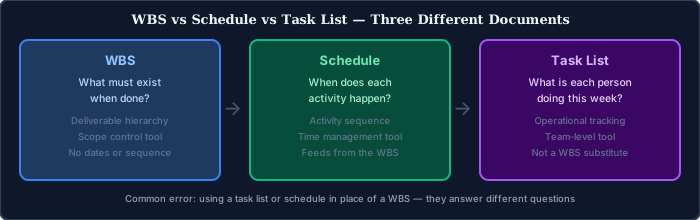
The most common confusion: WBS and schedule are not the same document. A schedule shows when things happen and in what sequence. A WBS shows what the project produces, arranged by deliverable hierarchy. Using one in place of the other is a scope control problem waiting to happen — I’ve reviewed projects where the “WBS” was a Gantt chart organised by phase, and when disputed variations arrived, nobody could answer the fundamental question: was this in scope or not? The Gantt told you the sequence. It told you nothing about scope boundaries.
How to Build a WBS That Gets Used
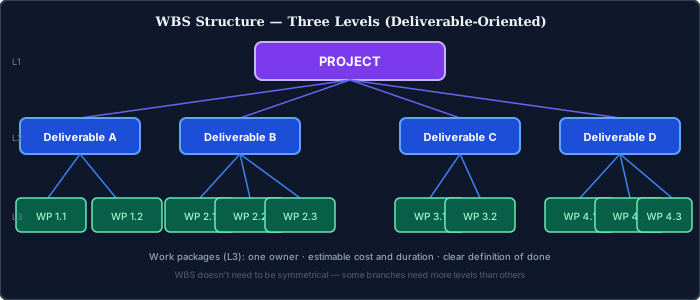
Start at the top — with what the project has to produce — and work downward. Not from a list of tasks built bottom-up, because that produces a schedule or a task list rather than a scope structure. Top-down decomposition starts with the end-state and asks: what are the major things that need to exist for this project to be complete? Each of those becomes a level 2 element. Then for each level 2 element, the same question: what sub-deliverables does this decompose into? Keep going until you reach something estimable, assignable and verifiable.
Start with the final deliverable
Level 1 of every WBS is the project itself. One box. One name. Everything else flows from it. This seems trivially obvious but it forces something important: agreement on what the project actually is. I’ve started WBS sessions where the room couldn’t agree on what went in the level 1 box, which meant we were doing scope definition that should have happened before the WBS.
Identify the major deliverable groups
Level 2 is the most important level. These are the major chunks the project produces — not phases, not departments, not activities. Deliverables. On a building project: structure, envelope, fit-out, MEP services, external works, commissioning. On a software project: requirements, architecture, developed system, tested system, deployed system, documentation. On an event: venue, content programme, logistics, communications, staffing.
Getting level 2 right means the WBS is usable as a scope map. Getting it wrong — by using phases or organisational units instead of deliverables — produces a structure that’s hard to maintain, because what happens when a phase is “done” but the deliverable it was supposed to produce isn’t? The WBS stops reflecting reality and gets abandoned.
Decompose to work packages
Keep decomposing each level 2 element until you reach work packages — units of work that can be estimated, assigned and tracked. A work package has: one responsible person or team, a clear definition of done (what does “complete” mean for this package?), an estimated cost and duration, and a verifiable output. If you can’t define what “done” looks like for a WBS element, it’s not a work package yet. Keep decomposing.
Build it with the people who’ll do the work
I’ve never seen it done in isolation that was right. Not once. Not wrong in small ways — wrong in ways that only the people doing the work could know about. On a civils project: the planning engineer decomposed “groundworks” into four work packages without knowing that the geotechnical report had flagged a ground stability constraint that made two of those packages sequential rather than parallel. The constraint was known. It just wasn’t in the room when the WBS was built. Four weeks in: an 8-week slip. Entirely predictable. From information that already existed.
Work Breakdown Structure Example: Construction Project
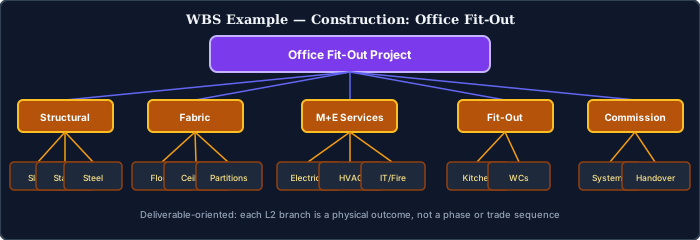
A work breakdown structure in construction is typically deliverable-oriented, reflecting the physical elements of the structure rather than the trade sequence or the programme phases. This is the distinction that experienced construction planners get right and inexperienced ones often don’t: the WBS structure should remain stable even as the programme changes.
Below is a work breakdown structure example for a commercial office fit-out project, Level 1–3:
| Level 1 | Level 2 | Level 3 (Work Packages) |
|---|---|---|
| Office Fit-Out Project | Structural alterations | Slab penetrations · Stair cores · Structural steel |
| Building fabric | Raised floors · Suspended ceilings · Partitions · Glazing | |
| M+E services | Electrical distribution · Lighting · HVAC · IT infrastructure · Fire detection | |
| Fit-out | Kitchen/break areas · WC fitout · Reception · Furniture install | |
| Commissioning | Systems commissioning · Snagging · Handover documentation |
A real construction WBS failure — and what it cost
On a hospital extension project I reviewed mid-delivery, the WBS had been structured by phase rather than by deliverable. Level 2 elements were “design stage,” “procurement stage,” “construction stage,” “commissioning stage.” Clean, logical, and a scope control disaster. When variations started arriving — from the client, from the statutory authority, from ground condition discoveries — nobody could say with certainty whether a particular variation was inside existing scope or outside it, because “construction stage” could mean almost anything. By the time I was looking at it, the project had processed 43 variations. Fourteen were disputed. The root cause of every disputed variation was traceable to the same thing: a WBS that described time rather than deliverables, which made it impossible to say with any precision what the original scope contained.
The fix was to rebuild the WBS deliverable-by-deliverable retrospectively — which took three weeks, involved the quantity surveyor, the project manager and the client’s representative, and produced a document that everyone agreed described the original scope. It also showed that four of the disputed variations were in scope all along. One was genuinely additional. The rest: genuinely disputed. Legitimate reasons on both sides. That three-week exercise would have taken three days at the start. It always does.
Two things deliberately absent from this structure: procurement and project management. Procurement isn’t a deliverable — it’s a process that produces the physical elements listed above. Project management is overhead. Neither should appear as a WBS branch in a deliverable-oriented structure. Dates and sequences are also absent — those belong in the programme. The WBS feeds the programme; it doesn’t contain it.
Where the work breakdown structure in construction genuinely earns its keep is in scope control conversations. When a client asks whether “smart building controls” is included in the project, the answer should come from the WBS. Either “IT infrastructure” under M+E services covers it, or it doesn’t, and it needs to be added as a work package with its own cost and programme implications. The WBS makes that conversation concrete rather than vague.
Work Breakdown Structure Example: Software Project
Software projects produce a different kind of WBS than construction, partly because the deliverables are less tangible and partly because agile development has made some teams skeptical of WBS altogether. The skepticism is partly warranted — a WBS for a software project shouldn’t be decomposed to individual user stories, which belong in the product backlog, not the WBS. But the project still needs to define its scope at a level above the backlog, and that’s what the WBS is for.
A work breakdown structure example for a software development project — enterprise CRM system replacement, approximately 18 months:
| Level 2 deliverable | Level 3 work packages |
|---|---|
| Requirements | Business requirements document · Data migration specification · Integration requirements · Non-functional requirements |
| System design | Architecture design · Database schema · API specification · Security design · Infrastructure design |
| Developed system | Core CRM modules · Customer data migration · Third-party integrations · Reporting module · Admin portal |
| Tested system | Unit test suite · Integration test results · UAT-ready build · Performance test report · Security audit report |
| Deployed system | Production environment · Deployment runbook · Rollback procedure · Go-live sign-off |
| Enablement | User training materials · Administrator documentation · Support handover · Post-go-live support period |
The “tested system” and “deployed system” are separate deliverables in this WBS because they’re separate things with separate owners and separate acceptance criteria. A common mistake on software projects is collapsing testing into development — making “tested system” a sub-element of “developed system.” This almost always produces inadequate test coverage because testing gets squeezed when development runs over, which it nearly always does. The WBS should reflect what you want to be true, not just what tends to happen.
What’s not in this WBS: project management. PMBOK allows it as a branch. I’d cut it. Project management is overhead; it doesn’t produce a deliverable that the client receives and accepts. If the contract requires PM deliverables — execution plans, monthly reports, risk registers — those can sit under a “project controls” branch. But “project management effort” as a WBS element inflates the structure without adding scope clarity.
Work Breakdown Structure Example: Event Management
Event management WBS structures are useful because they illustrate how the decomposition principle works in a non-technical, high-dependency environment. Everything about an event is interconnected — change one element and you change several others — which makes scope clarity particularly important.
Below is a work breakdown structure example for a 500-person professional conference, broken to Level 3:
| Level 2 | Level 3 work packages |
|---|---|
| Venue | Main auditorium · Breakout rooms · Catering areas · AV setup · Signage and wayfinding |
| Content programme | Keynote sessions · Workshop programme · Panel discussions · Speaker briefing packs · Session recordings |
| Logistics | Delegate registration system · Accommodation block · Transport arrangements · On-site staffing · Event app |
| Communications | Delegate invitations · Speaker communications · Sponsor materials · Social media content · Post-event report |
| Commercial | Sponsorship packages · Delegate ticket sales · Exhibition space · Budget reconciliation |
The value of building this WBS before detailed planning begins: it surfaces dependencies. “Event app” under logistics connects to “delegate registration system,” “session recordings” under content, and “social media content” under communications. Before you’ve planned any of it, you can see that those four work packages need to be coordinated. Without the WBS, each would be planned in isolation and the connections would only emerge as problems.
What Makes a Work Breakdown Structure Fail
Activity-oriented instead of deliverable-oriented
The most common structural error. “Conduct site surveys,” “hold design workshops,” “complete procurement” — these are activities. They’re useful in a schedule. In a WBS they make scope control impossible, because activities end but the deliverables they were supposed to produce may not exist yet. A WBS built on activities tends to be abandoned during execution because nobody can tell from it whether the project is on scope.
Too many levels
The WBS that goes to Level 6 on a six-month project. Each work package is two days of effort. The PM spends more time maintaining the WBS than delivering the project. The 8/80 rule — work packages between 8 and 80 hours — exists for a reason. Below 8 hours you’re micromanaging. Above 80 hours the package is too large to track meaningfully. Most projects are well served by three or four levels, with some branches going deeper where complexity demands it.
Built once and never updated
The WBS is a living document. When scope changes are approved through change control, the WBS should reflect them. I’ve reviewed projects where the WBS was produced at planning and never touched again — while the scope grew substantially through approved changes. The WBS showed the original scope. The programme, the cost reports and the team’s actual workload showed something else. That gap makes project reporting unreliable and makes it very hard to determine after the fact whether overruns were caused by scope growth or by poor performance.
No WBS dictionary
The WBS diagram alone is ambiguous. “Foundation works” in a construction WBS — does that include piling? Temporary works? De-watering? The WBS dictionary provides a definition for each element: what’s included, what’s excluded, acceptance criteria, assumptions. Without it, two people can look at the same WBS element and assume different scope. The dictionary converts the visual structure into a contract with the team about what the project will produce.
How Many Levels Is Enough?
The decision rule: decompose to the level where you can reliably estimate cost and duration, assign clear accountability, and define what “done” looks like. Stop. That level varies by project and by branch within a project — some elements need four levels, some need two. The WBS doesn’t have to be symmetrical.
On a three-month internal IT project, three levels is probably enough. On a major infrastructure programme running five years, four or five levels might be needed in some branches while three is sufficient in others. The WBS doesn’t have to be symmetrical — not every branch needs the same depth. What matters is that every work package at the lowest level of each branch meets the three criteria: estimable, assignable, verifiable.
A useful test: take any element in your WBS and ask whether the person responsible for it could tell you when it’s done, what it would cost to do, and who’s doing it. If the answer to any of those is “I’d need to talk to someone else first,” the element needs to be decomposed further or the responsibilities clarified.
WBS in the PMP Exam
The PMP and CAPM exams test WBS primarily through questions about decomposition, work packages, and the WBS dictionary. Scenario questions typically ask you to identify what belongs in a WBS versus what belongs in other documents, or to recognise when a WBS is being constructed incorrectly.
Key points for exam purposes: the WBS represents 100% of the project scope — nothing is done on the project that isn’t in the WBS, and everything in the WBS is part of the project. The lowest level of the WBS is the work package. Work packages are planned into schedule activities, but activities are not the same as work packages. The WBS dictionary defines each element. The WBS is an input to cost estimating, schedule development, risk identification and resource planning — it’s not an output of those processes.
For related scope management concepts, see the articles on project life cycle phases and project risk management. The PMI PMBOK Guide covers WBS construction and the WBS dictionary in the scope management knowledge area.

Victor Z Young is a Civil Engineer with 35 years of experience working alongside the executive team of various construction companies. Victor specializes in construction insurance, delay analysis, performance analysis and engineering. He holds a Doctor of Project Management from Northwestern University.