


The first time I submitted a PMP application, it was rejected. Not because my experience was inadequate — I had well over the required hours — but because the way I’d described my project management activities was too vague to pass PMI’s review. “Managed project delivery” tells an auditor nothing. “Led cross-functional team of eleven across design, procurement and construction phases, maintaining schedule baseline against a 22-week programme” tells them what they need to know. The application is the part most how to get PMP certification guides spend the least time on. It’s the part where most people waste months. This guide covers the whole process — eligibility, application strategy, audit risk, exam preparation and what to actually expect on the day.
Table of Contents
PMP Certification in 2026: What It Proves and Who It’s For
PMI issues the PMP. Something like a million people hold it now, and as of 2026 — the exact number changes but it’s in that territory. What that number actually means: when employers write “PMP preferred” in a job spec, they know what they’re asking for. It’s not the only PM credential, but it’s the one that crosses the most borders. In some sectors it means very little. In most it matters at least a bit.
The PMP certification eligibility requirements are designed to keep out people who’ve studied PM without practising it. The exam is scenario-based — 180 questions describing real situations rather than asking for definitions. Candidates who go in having memorised PMBOK terminology but without a mental model of how projects actually run tend to struggle. The ones who do well are usually the ones who’ve been doing this for a few years and can read a scenario and intuit what a competent PM should do next — even if they don’t know which PMBOK process it belongs to.
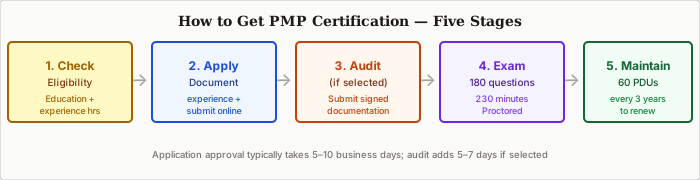
PMP Certification Requirements: Education and Experience
PMI runs two eligibility tracks. If you have a four-year degree — any subject — you need 36 months of PM experience to qualify for the PMP certification. If you have a high school diploma or associate’s degree, it’s 60 months. Both tracks require 35 hours of formal project management education, completed before you apply. That’s the non-negotiable one. No exceptions.
The experience calculation tripped me up badly. My thinking was: two projects running simultaneously for 18 months, that’s 36 months. PMI disagrees. They count non-overlapping months. Concurrent projects during the same period count as that period, once. I had to go back and dig out two older projects I’d completely forgotten about — a small office refurbishment from 2013 and a retail unit fit-out that I wasn’t even sure I could still get documentation for. Found them. Just about. PMI requires months of experience leading projects — not months of working on projects. The distinction matters. Being a team member on a five-year programme doesn’t give you five years of qualifying experience if you weren’t leading or directing project work. Overlapping projects don’t add up — if you led two projects simultaneously for 12 months, that counts as 12 months, not 24. And the experience must be within the last eight years.
My advice before you start the PMP certification application: do the experience calculation in a spreadsheet first. List every project, start month, end month, whether you were leading it. Mark the overlapping periods. The total non-overlapping months needs to be at least 36 (degree) or 60 (no degree). If you’re close but not quite there, don’t apply yet. Wait. The application fee is non-refundable.
How to Document Your Experience When You Apply for PMP Certification
Experience documentation is where most rejections and audit failures happen. PMI requires you to describe your project management experience in specific terms — the project, your role, and what you actually did. The descriptions need to align with PMI’s process groups: Initiating, Planning, Executing, Monitoring and Controlling, and Closing. You don’t need to use those exact labels, but the activities you describe should clearly fall within them.
What a good project description looks like
Each project entry in the application requires: project title, organisation, your role, project objective, project budget, project team size, start and end dates, and a description of your PM responsibilities.
The description is where candidates lose marks. “Managed a construction project” tells an auditor nothing verifiable. “Led planning and execution of a 14-week commercial office fit-out across structural, M+E and fit-out phases; maintained schedule baseline, managed three subcontractor packages, reported weekly to client steering group; project delivered on programme to agreed specification” — that’s the level of specificity required. Each description should be 2-4 sentences. It should name your specific responsibilities, the scope of work, the team you directed, and the outcome.
What to actually include in the descriptions
Your descriptions should cover activities that map to PMI’s process groups — Initiating, Planning, Executing, Monitoring and Controlling, Closing. You don’t have to use those labels. But you do need the activities to be recognisable as PM work rather than technical delivery. Across all your projects combined, you want to have covered most of those groups.
Initiating activities: writing or contributing to a project charter, identifying stakeholders, gaining formal sign-off. Planning: building the schedule, developing the WBS, writing the risk register, agreeing scope. Executing: leading the team, managing subcontractors, directing work. Monitoring: tracking cost and schedule performance, managing change control, reporting to sponsors. Closing: obtaining acceptance, closing contracts, doing the lessons learned. You don’t need all of these in every project description. What you’re building across the application is a body of evidence, not a checklist.
Common Mistakes When Applying for PMP Certification
Vague role descriptions. “Assisted the project manager” does not qualify — you need to have been leading or directing, not supporting. Using technical rather than PM language — describing engineering outputs rather than PM activities. Overstating scope — claiming to have led a £50m programme when your actual responsibilities covered one workstream. Understating scope — being overly conservative about your role out of modesty. Both cause problems. Describe what you actually did, in PM terms, at the level of specificity the description above illustrates.
The PMP Audit Process: What Happens and How to Prepare
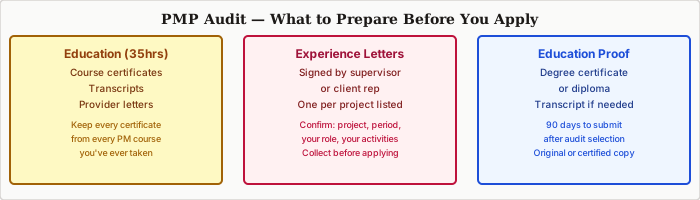
PMI randomly audits a percentage of PMP certification applications. Being selected for audit isn’t a sign that your application was questioned — it’s random. But it does require you to submit additional documentation within 90 days, and failing the audit means you lose your application fee and must reapply.
Audit preparation starts before you submit. The audit will ask you to: provide documentation of your 35 contact hours (course certificates, transcripts, or confirmation letters from training providers); provide signed letters from supervisors or clients confirming the project experience you described; and provide documentation of your educational qualifications. You need originals or certified copies. Certificates from online courses are acceptable — keep them.
Getting experience verification letters right
The letters must be signed by someone who can verify your experience — a direct supervisor, project sponsor, or client representative. They should confirm: that you worked on the project described, during the period described, in the role described, performing the activities described. The letter doesn’t need to be long. It needs to be specific, signed, and from a verifiable source. A letter from someone who has since left the organisation is acceptable as long as the contact details are current and the letter can be followed up.
The worst part for me, and I hear this from almost everyone who goes through audit, is chasing former managers and clients to sign letters verifying work you did four or five years ago. One of mine had left his company and set up on his own. I tracked him down through LinkedIn, explained what I needed, he was perfectly helpful — but it took three weeks I wasn’t expecting to spend. If you change employers regularly or work across multiple clients, start keeping a folder of confirmation emails after significant projects now. An email from your sponsor saying “thanks for delivering the X project on time” is audit gold years later even if it wasn’t written for that purpose.
Submitting Your PMP Certification Application: Step by Step
The application is submitted through PMI’s online portal. You’ll need a PMI account (free to create). The application itself has no fixed deadline — you can take as long as you need — but once submitted, you have 90 days to pay the exam fee (which triggers the audit window if you’re selected) and one year from payment to take the exam.
PMP exam fees (2025-2026)
| Membership status | Exam fee | PMI membership fee | Net cost with membership |
|---|---|---|---|
| PMI member | USD $405 | USD $139/year | USD $544 (saves ~$150 vs non-member) |
| Non-member | USD $555 | — | USD $555 |
| Re-examination (member) | USD $275 | — | USD $275 |
| Re-examination (non-member) | USD $375 | — | USD $375 |
PMI membership: honestly, only bother if you’re planning to sit the exam within the next 12 months. The fee discount on the exam more than covers the membership cost, and you get the digital PMBOK. But if you’re “thinking about it sometime next year,” you’ll pay the annual renewal and probably not use the benefits enough to justify it. Buy the membership, sit the exam, done.
The application process step by step
The portal is fairly self-explanatory. Create a PMI account, start an application, work through the experience entries one project at a time. Each entry needs: title, organisation, your role, what the project was for, rough budget, team size, dates, and the activity description. Fill the education section. Submit. PMI usually comes back within 5-10 business days. If it’s approved, you pay the exam fee. If they’ve selected you for audit — which is random, not a sign anything is wrong — you’ll get a different email with instructions. Don’t panic if that happens. It’s annoying but manageable.
PMP Exam Format and Content Outline
The PMP certification exam was significantly revised in January 2021 following PMI’s Examination Content Outline (ECO) update. The current 2026 ECO remains broadly consistent with that revision — predictive and agile content split roughly 50/50. The current exam reflects a hybrid approach to project management — roughly half predictive (waterfall) and half agile/hybrid — rather than the PMBOK-only focus of earlier versions.
| Exam element | Detail |
|---|---|
| Questions | 180 (including 5 pretest questions that don’t count toward score) |
| Time | 230 minutes |
| Format | Multiple choice, multiple response, matching, hotspot and drag-and-drop |
| Breaks | Two optional 10-minute breaks (time does not stop during breaks) |
| Pass mark | Not published by PMI — scored across Above Target, Target, Below Target, Needs Improvement |
| Delivery | Proctored test centre or online proctored (Pearson VUE) |
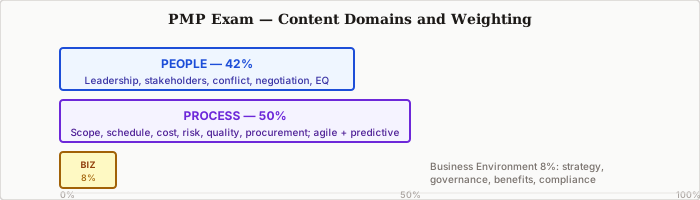
Content domains and weighting
| Domain | Exam weight | What it covers |
|---|---|---|
| People | 42% | Team leadership, stakeholder engagement, conflict management, negotiation, emotional intelligence, building high-performing teams |
| Process | 50% | Technical PM — scope, schedule, cost, quality, risk, procurement; predictive and agile approaches; schedule compression; EVM |
| Business Environment | 8% | Strategy alignment, benefits realisation, organisational change, governance, compliance |
The 42% weighting on People surprises candidates who prepared mainly on technical PM content. The exam is testing whether you can lead and manage people, not just whether you know how to build a schedule. Emotional intelligence, conflict resolution, and stakeholder management questions are numerous and scenario-based — “what should the PM do next” rather than “define earned value.”
PMP Exam Preparation Strategy
The PMP requires significantly more preparation than most people budget for. I went into my own exam after what I thought was thorough preparation and found the scenario questions harder than expected — not because I didn’t know the theory, but because the scenarios were testing judgment, not recall. PMI’s own guidance suggests 35+ study hours beyond the 35 contact hours. Most successful candidates I’ve spoken with report 100-200 hours of structured preparation. The range is wide because it depends heavily on how recent and active your project management practice is. Someone who has been actively managing complex projects using formal PM methodologies for five years needs less memorisation time than someone whose experience is older or less process-oriented.
What actually helped (and what didn’t)
The PMBOK 7th edition: don’t try to study from it. It’s a reference document, not a textbook. I made that mistake and spent two weeks reading something that didn’t directly prepare me for a single exam question. What you actually need: a course built around the current Exam Content Outline (post-2021 — make sure it’s not an old PMBOK 6 course), a solid practice question bank with scenario questions, and the Agile Practice Guide. The agile guide is non-negotiable. Nearly half the exam touches on agile or hybrid approaches and most traditionally-trained PMs are weak on it going in.
Practice questions are the most important preparation tool after initial concept learning. The exam is scenario-heavy — most questions describe a situation and ask what the PM should do. The best preparation for this is doing hundreds of scenario questions under time pressure, reviewing wrong answers carefully, and identifying the underlying principle each question tests. A bank of 2,000+ practice questions from a reputable provider (PrepCast, RMC, Agile PM Prepcast) covers the breadth needed. Questions from three years ago may not reflect the current ECO emphasis — check that your question bank has been updated post-2021.
Study schedule for 90-day preparation
My rough structure: the first month, cover the course material and read the Agile Practice Guide. Don’t skip the agile guide — I nearly did and I’m glad I didn’t. Month two, practice questions by domain. When you get something wrong, go back to the concept, not just the answer. Month three, full mock exams under timed conditions. Review every wrong answer. By the final two weeks I was scoring consistently above 75% on mocks and felt as ready as I was going to be. I stopped looking at new material three days before. That part I’d do again.
The agile gap — which is bigger than you expect
This is the one that gets people. Candidates from traditional PM backgrounds consistently underperform on agile questions. The exam doesn’t require you to have worked in Scrum — it requires you to understand when agile approaches are appropriate, how they differ from predictive approaches, and how to manage stakeholders and teams in an iterative environment. Read the Agile Practice Guide cover to cover. Understand sprint planning, velocity, retrospectives, the role of the product owner, and how agile risk management differs from risk registers. These topics appear throughout the exam, not just in a dedicated section.
What to Expect on PMP Certification Exam Day
The PMP is delivered by Pearson VUE — test centre or online proctored. I sat mine at a test centre and would do so again. Online proctoring works, but you’re one barking dog or incoming notification away from a proctor interruption, and that’s not what you want when you’re 90 questions in. Around 180 questions, just under four hours. The clock starts and doesn’t stop for breaks.
The exam has 180 questions and 230 minutes — roughly 76 seconds per question. This sounds tight and in practice it is. Scenario questions often have long stems — three to five sentences describing a situation before you reach the question. Speed matters more than most preparation resources acknowledge. What helped me: read the actual question first, then the scenario. Most scenarios are long. If you know what they’re asking before you read the context, you read faster. Flag uncertain questions, move on, come back. Don’t camp on one question.
The two optional breaks
Two optional breaks are allowed. Clock doesn’t stop. I took one, after question 90 or so — I’d lost track by that point honestly. It helped. If you’re behind on time, five minutes is enough, or skip it. The break exists; use your judgment.
What “Above Target” and “Below Target” mean
PMI doesn’t tell you the pass mark. You get Above Target, Target, or Below Target per domain. You can fail one domain and still pass overall if you’re strong enough elsewhere — at least that’s my understanding of how it works. The domain where people fail most often, from what I’ve seen, is People. That’s the 42% block. Most technically-trained PMs spend too little time on it.
Maintaining Your PMP: PDUs and the 3-Year Renewal Cycle
The PMP must be renewed every three years by earning 60 Professional Development Units (PDUs). PMI has a specific breakdown requirement — the PDUs must be earned across the Talent Triangle categories: Power Skills, Business Acumen, and Ways of Working.
| Talent Triangle category | Minimum PDUs | Examples |
|---|---|---|
| Power Skills | 8 | Leadership, communication, problem-solving, negotiation training |
| Business Acumen | 8 | Strategy, finance, benefit realisation, organisational change |
| Ways of Working | 8 | Agile, predictive, hybrid, technical PM methods |
| Any category | Remaining 36 | Flexible — any PM-related learning, volunteering, or giving back |
60 PDUs over three years sounds like a lot. It isn’t, really. Reading counts. Attending a webinar counts. I got 12 from a two-day conference without doing anything specific to collect them. The PMI portal for logging PDUs is mildly annoying to navigate — I’ll be honest about that — but five minutes per activity is about right. The people who end up stressed about renewal are the ones who ignore it for 30 months and then try to collect 60 PDUs in a sprint. Log as you go.
Is PMP Certification Worth It in 2026?
Depends on your sector. I’ll be direct about it. In construction, infrastructure, pharmaceuticals, and most large technology environments, the PMP appears in job specifications and matters for progression. In smaller organisations, niche specialisms, or places where everyone already knows what you can do — it’s largely invisible and probably not worth six months of your evenings. The check I’d do before committing: search for PM roles you actually want. Count how many say “PMP preferred.” If the answer is zero, ask yourself why you’re doing this. If the answer is five or more, get on with it.
PMI publishes salary data showing PMP holders earning 16-32% more depending on country. I wouldn’t build a business case around those numbers — the PMP selects for more experienced, more structured PMs who tend to earn more anyway, and that confounds the comparison. What I’d say from my own experience: the certification opened two conversations with clients that I don’t think would have happened otherwise, and it got me through a shortlisting filter on a role that specified it. That’s more concrete than a percentage.
The preparation process itself has value independent of the credential. Working through the PMBOK processes, the agile content, and 1,500+ scenario questions forces a level of systematic thinking about project management practice that most practitioners haven’t been through. I came out of my PMP preparation with a clearer conceptual model of what I was doing on projects and why — not because the PMBOK had taught me anything I wasn’t doing, but because it gave me a framework to articulate it. That has value regardless of whether the letters appear after your name.
For further reading on the PM knowledge areas the PMP exam draws from, see the articles on the risk management process, work breakdown structure, contingency and management reserve, and conflict management techniques. The PMI’s official PMP certification page is the definitive source for current fees, eligibility requirements and the exam content outline.

11+ years strategic communications, marketing, and project management experience. I am a trainer at StarWood Training Institute, focusing on online courses for project management professionals.



Right here is the right website for anyone who wants to find out about this topic.
You realize a whole lot its almost hard to argue with you (not that I personally would want to?HaHa).
You definitely put a fresh spin on a subject that has been written about for
decades. Wonderful stuff, just excellent!
You actually make it appear so easy along with your presentation but I in finding this matter to be
really one thing that I think I would never understand.
It kind of feels too complicated and very vast
for me. I’m having a look forward for your subsequent put up,
I’ll attempt to get the dangle of it!
I’ll right away snatch your rss as I can not find your email subscription hyperlink or e-newsletter service.
Do you have any? Kindly let me recognize in order that I
may subscribe. Thanks.
Thank you for sharing useful information.