


A cost benefit analysis puts the expected costs of a decision next to the expected benefits and asks whether the second column is bigger than the first. Project approvals, capital investment, hiring, infrastructure — it shows up everywhere. This article works through a cost benefit analysis example in detail, covering how the calculations actually work and where the process tends to break down. The version that most organisations actually produce is a different thing from what the methodology is supposed to be.
Table of Contents
Cost Benefit Analysis CALCULATION
The calculation isn’t what makes CBA hard. You list costs, list benefits, discount where needed, divide one by the other. BCR above 1.0 means the numbers say yes. The question is whether the numbers are honest, which the calculation itself can’t answer.
CBA done properly — honest assumptions, tested with sensitivity, baseline clearly defined — is a useful tool. The version that circulates in most organisations isn’t that. It’s a document produced after the decision has already been made, structured to justify it. I find it hard to say exactly when that became the norm.
The 43% cost overrun and two-thirds benefit realisation I mentioned above — that project had a pre-approval BCR of 2.3. The numbers were produced correctly. Nobody had fabricated anything. The assumptions had just been set at the optimistic end of a plausible range, none of them individually indefensible, which is how a 2.3 BCR becomes a 0.9 in hindsight.
How a Cost Benefit Analysis Works: the Core Steps
Before identifying costs and benefits, define what decision is being analysed and what the baseline is. Benefits are measured relative to a baseline — the do-nothing scenario. A project that “saves £200,000 per year” only generates that saving if the baseline would have spent that money. I’ve seen CBAs where no baseline was stated, just a list of benefits as if they were absolute. The BCR looks fine. The analysis is measuring the wrong thing.
Scope is where a lot of games get played. Analyse only the direct project costs and leave out wider system costs — the analysis looks better. On public sector appraisals, the commissioning body often sets the scope, which means costs that fall on other departments or organisations can be excluded without technically lying. Not always deliberate. But it happens, and it produces CBAs that are accurate within their stated scope and misleading in practice.
Identifying costs — what gets missed
Cost identification needs to be exhaustive. Capital costs, operating costs, maintenance, and support costs are usually included. Transition costs and opportunity costs are the categories most often dropped. Training staff on a new system takes time that isn’t in the capital budget. The productivity dip while people adapt to change is real and measurable. On a CBA I reviewed for a warehouse management system replacement, the implementation consultants had included software, hardware, and their own fees — nothing for the six weeks of reduced throughput while the team was learning the system. The actual impact was around £180,000 in lost margin. Not in the CBA. Not even mentioned.
Identifying and valuing benefits
Benefits should be specific and traceable to measurable outcomes: cost savings, revenue increases, productivity gains, risk reductions, intangible improvements. “Improved brand reputation” needs a mechanism — fewer churns, better pricing, new contracts — before it earns a number in the BCR. Without that causal link, it’s padding.
Discounting for multi-year analyses
The discount rate converts future costs and benefits to their present-day equivalent. Higher rates hurt back-loaded benefits more than upfront costs — which is why discount rate selection is a lever that gets pulled when someone needs a particular BCR. UK Treasury uses 3.5% for most social infrastructure. Commercial projects typically use 7–10% depending on risk profile. The one that recurs: a commercial investment appraisal using 3% because it nudges the BCR above 1.0. Nobody says that’s why. The justification is usually something about long-term social value.
Benefit-cost ratio (total discounted benefits ÷ total discounted costs) and net present value (total discounted benefits minus total discounted costs) are the two standard outputs. BCR above 1.0 and NPV above zero both mean the same thing: benefits exceed costs given the inputs used. Sensitivity analysis — what happens if costs run 20% over, or benefits come in 20% short — turns those numbers into a range rather than a single point.
Worked Cost Benefit Analysis Example
In this cost benefit analysis example, a manufacturing company — the kind that runs two shifts and has been on the same scheduling software since before the current IT manager started — is deciding whether to replace it. The system works. It just requires three people to do things that should be automated, doesn’t talk to the ERP, and generates a lot of spreadsheets. Five-year horizon, 6% discount rate because that’s what they used last time.
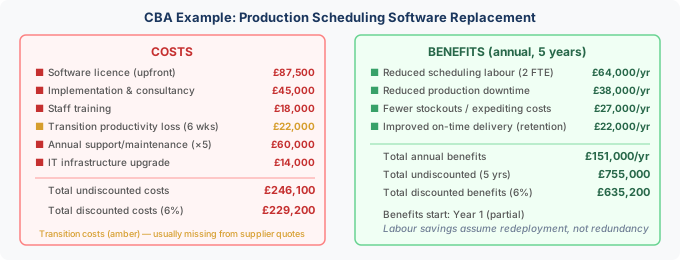
The transition productivity loss (£22,000) is the item highlighted in amber for a reason — it doesn’t appear in any supplier quote and requires the organisation to produce its own estimate. Most don’t bother. The labour saving assumes redeployment rather than redundancy, which is defensible if the business is growing but needs to be stated. “Improved on-time delivery (retention)” is the most uncertain line — it assumes a causal link between delivery performance and customer retention that I’d want tested against the actual customer data before putting a number on it.
Benefit-Cost Ratio and NPV
The numbers from the cost benefit analysis example:
| Metric | Calculation | Result |
|---|---|---|
| BCR | £635,200 ÷ £229,200 | 2.77 |
| NPV | £635,200 − £229,200 | £406,000 |
| Payback | £246,100 ÷ £151,000 | ~1.6 years |
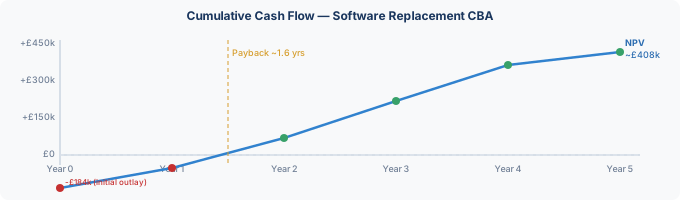
Payback here is on undiscounted flows — the discounted version runs to about 1.9 years. BCR of 2.77 is a strong result. Whether it holds depends on the benefit assumptions. If the labour saving is £40,000/yr rather than £64,000/yr — which would happen if only one FTE was actually redeployed rather than two — and the delivery retention benefit doesn’t materialise, the BCR drops to around 1.6 and the payback extends past two years. Still a reasonable case — just not the one in the summary slide.
Intangible Costs and Benefits
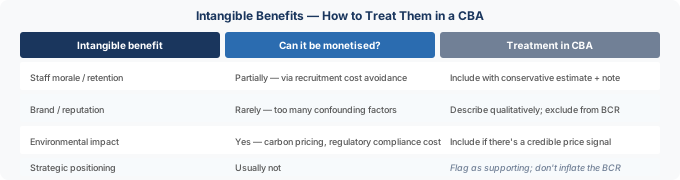
Some costs and benefits don’t have prices. Staff morale, brand reputation, environmental impact, strategic positioning — real in varying degrees, hard to value reliably. Listing them qualitatively alongside the BCR is fine. Assigning them numbers specifically to push the BCR above 1.0 is the version to watch out for.
List intangibles, describe them qualitatively, and be honest about whether they’re decision-relevant or just filling out the form. With a BCR of 2.77, listing intangibles as additional supporting evidence doesn’t change anything — the quantifiable case is strong enough without them. At a BCR of 1.1, those same intangibles become load-bearing, and they need to be scrutinised rather than treated as a given. The distinction matters because intangibles are easy to inflate and hard to challenge.
Where Cost Benefit Analyses Go Wrong
Optimism bias. Most CBAs are commissioned by people who want a particular outcome. That preference shapes everything — which benefits get included, what values they get assigned, what discount rate gets used. None of those individual choices has to be dishonest. You can arrive at a BCR of 2.77 through a sequence of individually defensible optimistic assumptions and still be wrong about whether the investment will pay back.
The data on this is fairly grim. Large infrastructure and IT programmes overrun cost by 20–45% on average; benefit realisation typically falls 20–30% short of appraisal. Not occasionally — routinely. Reference class forecasting was developed specifically to address this: anchor your estimate on what comparable projects actually delivered, then adjust. It works better than bottom-up appraisal. It also produces lower BCRs, which is probably why organisations are slow to adopt it.
I don’t know what actually fixes this. Mandating reference class forecasting helps in theory. Requiring sensitivity analysis helps a bit. Neither changes the basic dynamic, which is that the person commissioning the CBA usually wants a specific answer and the analysis gets shaped around that. I’ve stopped expecting CBAs to be neutral documents.
Asymmetric scoping. Costs grow as a project progresses and requirements become clearer. Benefits, by contrast, get scoped conservatively at appraisal to make them defensible. The two trends compound in the wrong direction. A cost contingency of 15–30% depending on how far into design you are isn’t pessimism — it’s calibration to what projects actually do. A CBA with no contingency allowance is giving the impression of precision it hasn’t earned.
Wrong discount rate. Discount rate selection significantly affects multi-year CBAs. A 3% discount rate applied to benefits realised in years 4 and 5 is very different from a 10% rate. In the software example above, changing the discount rate from 6% to 12% reduces the NPV from £406,000 to around £290,000 and the BCR from 2.77 to 2.4. Still positive, but the point is that the choice of discount rate should be driven by the risk profile of the benefits, not chosen to produce a favourable result. Public sector bodies typically use a mandated rate (the UK Treasury uses 3.5% for most social projects; 5–7% for commercial projects). Private sector analyses should use the organisation’s cost of capital or hurdle rate.
Missing sensitivity analysis. A single BCR, without any test of how sensitive it is to the input assumptions, doesn’t tell you very much. What happens if costs run 20% over? If the main benefit stream is delayed a year? If the discount rate is higher? Those things happen. If the BCR stays above 1.0 under all of them, the case is reasonably robust. If it drops below 1.0 when costs overrun by 20% — and 20% cost overruns are not unusual — then the business case is contingent on cost control, and the approval should say so. That’s rarely how approvals are written. What goes into the executive summary is the base case BCR. The scenarios where it falls below 1.0 sit in a table on page 14 that three people read.
If you’re building a budget around the outputs of a CBA, the baseline budget article covers how to structure that. The project life cycle article is useful for understanding where CBA typically sits in the approval sequence and what decisions it’s actually informing.
A Real-World Cost Benefit Analysis Example: Software Company Hiring Decision
Software company. Three years old, five coders, decent pipeline, and a backlog they can’t get through without outsourcing testing at $80 an hour to another firm. The question was whether to hire three more developers and move offices, or keep running lean.
Before running any numbers, the right starting point is a brainstorming session with the relevant stakeholders — finance, operations, and the team leads who understand day-to-day capacity. The goal is to surface all costs and benefits before any of them get anchored to a number. In practice, the costs that get missed are almost always the ones nobody thought to raise in the first meeting: onboarding drag, reduced short-term productivity while new hires find their feet, and the hidden cost of the existing team’s time spent supporting them.
Costs (Year 1)
| Cost item | Detail | Year 1 cost |
|---|---|---|
| Additional office rent | Moving to larger premises | $15,000 |
| Office fit-out | Furniture, equipment, decoration | $10,000 |
| 3 new hires (salary + benefits) | $40,000 each including onboarding | $120,000 |
| Hardware and software licences | 3 machines + dev tools | $10,000 |
| Transition downtime | Reduced output during onboarding (~6 weeks) | $20,000 |
| Total Year 1 costs | $175,000 |
Benefits (Year 1)
| Benefit item | Detail | Annual value |
|---|---|---|
| Revenue increase (30%) | Baseline $100,000/yr → $130,000/yr | $30,000 |
| Outsourcing saving | 200 hrs/month at $80/hr replaced by in-house at ~$52/hr | $67,000 |
| Productivity uplift | 5% improvement across 8 coders, avg $40k salary | $16,000 |
| Total annual benefits | $113,000 |
Payback period: $175,000 ÷ $113,000 = approximately 1.55 years, or around 18–19 months. BCR = $113,000 ÷ $175,000 = 0.65 in year one — which looks negative, but that’s because all the capital and setup costs land in year one. By year two, with $113,000 of annual benefits and no further capital outlay, the cumulative position turns strongly positive.
The revenue increase benefit ($30,000) is the most uncertain item. It assumes a direct causal link between capacity and revenue — that the company is currently turning away work or losing contracts due to bandwidth constraints, and that new capacity will translate to new sales. If that link doesn’t hold, the BCR deteriorates significantly. Whether it’s a reasonable assumption depends on the company’s pipeline and market position. The CBA should state it explicitly and flag it as a key sensitivity.
Tracking actual cash flows against CBA projections after implementation is something most organisations skip entirely. Comparing what the analysis predicted against what actually happened — particularly for benefit streams — is one of the most useful organisational learning exercises available. The cash flow management article covers how to structure the ongoing tracking of costs and benefits once a project is underway.
Comparing Alternatives: Two Real Estate Projects
When a CBA is used to compare alternatives rather than evaluate a single investment, the question changes from “is this worth doing?” to “which of these is worth more?” The comparison needs to be made on a consistent basis — same analysis period, same discount rate, same treatment of residual values.
Consider a construction company board evaluating two residential development projects. The simplified parameters:
| Project 1 | Project 2 | |
|---|---|---|
| Units | 500 (400 sold, 100 rented 20 yrs) | 400 (350 sold, 50 rented 15 yrs) |
| Construction cost/unit | $100,000 | $90,000 |
| Sale price/unit | $120,000 | $135,000 |
| Annual rental/unit | $4,000 | $4,500 |
| Project duration | 3 years | 2 years |
| Sales office cost | $2,000,000 | $3,000,000 |
| Annual sales personnel | $300,000/yr | $250,000/yr |
| Annual financing cost | $3,000,000/yr | $2,500,000/yr |
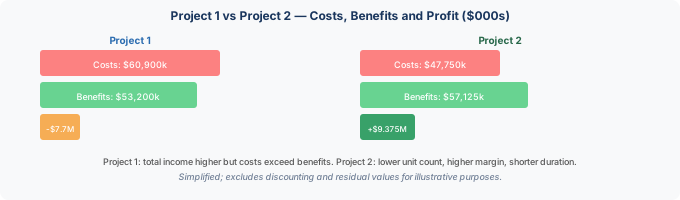
In this cost benefit analysis example, Project 2 wins on margin despite fewer units. Higher per-unit price ($135k vs $120k), lower construction cost ($90k vs $100k), shorter duration — so two fewer years of financing and sales personnel running. The board would have made the wrong call looking only at total revenue. I’ve seen this exact type of mistake made on a real development decision, though not with these numbers. The project with more units got approved partly because the headline income figure was bigger and nobody ran the cost side properly.
Neither of these projects has been discounted. The $57m of Project 2 benefits arrive over 15 years — rental income plus a terminal sale. Once you discount that, the gap between the two projects narrows. I haven’t run the full discounted comparison here because the underlying data is simplified anyway, but for an actual board decision at this scale, the undiscounted table is a starting point, not a conclusion.
Sensitivity Analysis in a Cost Benefit Analysis Example
Sensitivity analysis tests how much the result changes when you move the key inputs. Single-point BCR without sensitivity is an assertion, not an analysis. The variables worth testing:
| Variable | Base case | Pessimistic | BCR impact (software example) |
|---|---|---|---|
| Implementation cost | £246,100 | +20% → £292,800 | 2.77 → 2.15 |
| Annual benefits | £151,000/yr | -20% → £120,800/yr | 2.77 → 2.21 |
| Benefits delayed 1 year | Start Year 1 | Start Year 2 | 2.77 → 2.29 |
| Discount rate | 6% | 12% | 2.77 → 2.38 |
| Cost + benefit combined stress | Base | Costs +20%, benefits -20% | 2.77 → 1.58 |
The combined stress test at the bottom is the most honest scenario. It applies a cost overrun and a benefit shortfall simultaneously — which is what actually tends to happen on projects. A BCR of 1.60 under combined stress still represents a positive case, but it’s materially different from 2.79. A decision-maker seeing only the base case BCR is seeing the best version of the analysis. The sensitivity table is what makes the CBA honest.
There’s no universal rule for how much sensitivity is “enough.” A project that stays above BCR 1.5 under all stress scenarios is robustly positive. A project that falls below 1.0 under a single plausible scenario probably shouldn’t be approved without additional conditions — cost caps, staged approvals, or benefit guarantee mechanisms — being built into the decision. That nuance rarely makes it from the sensitivity analysis into the executive summary.
See Also
Expected Monetary Value Calculation
Further Reading
[1] The social CBA

A dedicated Career Coach, Agile Trainer and certified Senior Portfolio and Project Management Professional and writer holding a bachelor’s degree in Structural Engineering and over 20 years of professional experience in Professional Development / Career Coaching, Portfolio/Program/Project Management, Construction Management, and Business Development. She is the Content Manager of ProjectCubicle.



I am the student of environmental science department and progress my education
It’s very good
i am a student of Computer system Engineering and it is very helpful for me
ensoft, a software house, is considering developing a payroll application for use in academicinstitutions and is currently engaged in a cost-benefit analysis. Study of the market has shownthat, if they target it efficiently and no competing products become available, they will obtain ahigh level of sales generating an annual income of £800,000. They estimated that there is a 1 in10 chance of this happening. However, a competitor might launch a competing applicationbefore their own laun
NEED SOLUTION
The Board of Quest plc is due to meet to consider investing in a new project which will allow the company to diversify its existing product range. Before the meeting the Finance Director, has asked you, to evaluate the project using the following information.
Market research has been undertaken at a cost of HK$500,000 which shows that the project will result in the following cash flows:
Year 1
Year 2
Year 3
Year 4
Sales volume (units)
100,000
130,000
130,000
90,000
Selling price (HK$/unit)
472
523
551
660
Variable cost (HK$/unit)
275
315
351
403
Fixed costs (HK$)
8,760,000
9,030,000
9,320,000
9,610,000
These forecasts are after taking account of selling price inflation of 3·0% per year, variable cost inflation of 6·0% per year and fixed cost inflation of 3·5% per year.
In addition included in the fixed costs is a figure of HK$1,000,000 which represents an apportionment of general overheads. The balance of the fixed costs are incremental fixed costs which are associated with the new project.
The total machinery costs of the project in year 0 are estimated to be HK$40,000,000 and the machinery from the project will be sold for scrap with a value of HK$4,000,000 at the end of year 4.The company will also have to spend HK$ 3,000,000 refurbishing the building before the new machinery can be installed.
Quest plc pays corporation tax of 25% per year. This is paid in the following year (i.e. one year in arrears) Capital allowances on an 18% reducing balance basis are available on the machinery only. A balancing charge or allowance is available at the end of the fourth year of operation.
Quest plc has a real cost of capital of 9% and the general rate of inflation is 3.7%
Required:
Recommend to the Board whether the project should be undertaken by:
Calculating the nominal after-tax Net Present Value of the new project using the money cost of capital.(Round to the nearest whole number)
Calculating the Internal Rate of Return of the new project.
After the Board meeting, you were asked to consider the risk of the project and you have reported back to the board that the Expected Net Present Value and the Standard Deviation of the project are HK$1,290,000 and HK$1,640,000 respectively.
Required:
Calculate the percentage probability that the project will be value destroying (you can assume a normal distribution of outcomes.) and briefly discuss the difficulties of using probability analysis in incorporating risk into investment appraisal.
One of the directors thinks that incorporating inflation into the calculation in the way outlined above is too time consuming and just adds more costs to the business without giving a significant benefit.
Required:
Explain one other way that inflation can be incorporated in the NPV calculation and discuss which method you think the company should adopt.(use the figures above to support your answer)
can I have an example of cost-benefit analysis of a road construction project in excel form. please.
Very helpful. Thank you very much. May I have a a social cost benefit analysis = one that does not have financial or tangible benefits. For example, introducing social workers in schools to eliminate cases of child suicides.
1. A government is considering building a tunnel across a sea channel which can currently only be crossed by ship. The following Information is available.
(i) The tunnel will consist of a tow- truck railway and cars and passengers will be carried by train. It will cut crossing time by two hours for car and passengers.
(ii) The relevant categories of traffic are:
(a) Cars (and their passengers)
(b) Passengers not in cars
(c) Freight
(iii) The authorities who would operate the tunnel have decided to charge a toll which would maximize revenue. The toll that they have decided to charge is 160 per car which compares favorably with the charge by ship which is 200.
(iv) Because of the quicker and chipper journeys available, it is forecast that the following traffic per year for the foreseeable future will be diverted from the existing method of travel:
75,000 cars (with the average of two passengers)
50,000 passengers not in cars
350,000 tonnes of fright
In addition 50,000 extra car journeys (with two passengers each) will be made.
(v) The average value of passenger’s time is 6 per hours.
(vi) The diverted traffic will reduce the cost of operation of the existing ship by 40 million a year, while at the forecast levels of traffic, the maintenance and operating cost of the tunnel will be 3 million. Its capital cost will be 400 million. The life of the tunnel will be 50 years.
(vii) Assuming that the monetary figures given the above reflect social value, calculate the IRR of the streams of social costs and benefits.
2. A government is considering whether it should close down the branch line passengers services from station A to station B. no good are currently carried by rail. The chief accountant of the government estimate the annual cost of the train movement, track maintenance, signaling, and other expense to be 1, 520,000, including 120,000 toward depreciation and interest charges. If the line were closed at any time, the diesel train operating on it could be sold to another country for 240,000. Noting else has any re-sale value the line is used for 1000 single Journeys each day (250 days per year). The single fare is 4.00. So the line is losing money, a deficit met by taxation. If the line is closed, It is estimated that of the former journeys 800 will be made by bus (at the same fare) and 200 will not be made. The bus fare is the same as the rail fare and the extra bus fares exactly offset the bus operations extra cost. Bus journey takes an average of 40 minute longer than the rail journey. The average value of passenger’s time is 2 per hour. Enumerate the social costs and benefits associated with the proposal.
This post on cost-benefit analysis is incredibly helpful! The step-by-step approach makes it easy to understand, and the example you provided really clarified how to apply the concepts in real situations. I appreciate the emphasis on both tangible and intangible benefits. Thank you for sharing such valuable insights!
This blog post really breaks down the cost-benefit analysis process clearly! The example provided helped me understand how to apply the steps in real-life scenarios. I appreciate the practical tips and the straightforward language. Looking forward to more posts like this!