

Construction claims management is one of those disciplines where the expensive failures are almost never dramatic. Somewhere around the fifteenth or sixteenth time I sat across a table from a project manager watching their case evaporate — not on the merits, not because the facts were wrong, but because a notice hadn’t gone out and a diary hadn’t been kept — I stopped being surprised. This keeps happening. Not occasionally. Constantly. On big projects and small ones, in every sector, with contractors who absolutely know better.
Table of Contents
So this is less of a comprehensive guide to construction claims management and more of an argument: most claims that fail, fail early. Not at the hearing. Not in mediation. Weeks or months before any dispute is declared, when the evidentiary record was either built or wasn’t, and when the notice window either received attention or didn’t. Everything that comes later — the TIA, the quantum report, the mediation sessions — works with whatever that earlier period produced. If the record is thin, even the best claims consultant is doing damage control.
Where Construction Claims Management Goes Wrong
The Training Problem
Construction claims management training, where it happens at all, tends to go to quantity surveyors and project managers. That’s the wrong group. Or not wrong exactly, but incomplete in a way that matters. The people who actually create the evidentiary record — site supervisors, foremen, engineers watching conditions arise and instructions given — mostly receive none of it. They write their diaries the way someone showed them on their first job, which is often not rigorous, and nobody connects that habit to what happens two years later in arbitration.
I’ve watched opposing experts pick up site diaries and note the gaps. A week with no entries. Three days recorded in retrospect on a single page. Weather logged as “fine” on a day when met records show heavy rain. These aren’t necessarily dishonest — diaries get written in batches when work gets busy — but they lose the probative value a contemporaneous record carries. And the opposing expert’s job becomes much easier.
The people best placed to prevent this are not the QS. They’re the people on site. They’re also usually the last ones anyone thinks to train on construction claims management procedures.
The Notice Window — and Why It Keeps Closing
FIDIC’s Time-Bar
FIDIC’s 2017 editions — the Red, Yellow, and Silver Books — impose a 28-day time-bar under Clause 20.2.1. Miss that window and entitlement is gone. Not weakened. Gone. The engineer issues a determination that the claim is time-barred, and that becomes the starting point for everything that follows — usually an uphill procedural fight rather than an open argument on the merits.
The clock runs from when the contractor became aware of the event — or should have become aware. Not from when they decided to pursue a claim. Not from when they understood the full scope of the impact. From when a reasonable person in their position would have recognized that a compensable event occurred. In practice, that’s often weeks before anyone in the commercial team heard about it. The site team was dealing with the problem rather than flagging it as a construction claim event.
The 2017 editions tightened this compared to the 1999 forms. Under the older FIDIC, parties could argue that a late notice hadn’t prejudiced the other side and shouldn’t be fatal. That argument has much less purchase under current language. I think the time-bar in its current form is punitive in a way that doesn’t serve either party well — it rewards procedural discipline over substantive merit — but that’s a separate conversation. For now it’s the rule, and teams on 2017 FIDIC contracts need to treat 28 days as absolute.
NEC4 and the Early Warning Mechanism
NEC4 works differently and, in my view, more sensibly. The compensation event mechanism under Clause 61.3 gives 8 weeks. But the whole NEC4 framework builds around early warning rather than time-bar. Clause 15 requires notification of anything that may affect time, cost, or performance — as soon as practicable. The contract then assesses compensation as if the warning went out at the right time. Miss it, and quantum calculates against a theoretical earlier notification date. That can produce a materially different number.
The design logic is sound: flag problems early so both parties can manage them together. Whether it works that way in practice depends on whether teams genuinely use the early warning mechanism or treat it as a formality. That varies considerably.
JCT is less prescriptive — the standard is notice “forthwith,” and late notice reduces rather than eliminates entitlement. AIA A201 in the US gives 21 days. ConsensusDocs gives 14. Bespoke contracts sometimes go shorter. Read the specific provision before the project starts.
A Simple Fix That Actually Gets Implemented
Add notice deadline review as a standing five-minute item in the weekly site meeting. Not a discussion — a check. Are any open issues approaching a contractual window? Most weeks, nothing. The weeks when the answer is yes are exactly the weeks when everyone is too busy with the live problem to think about it. So put it in the structure.
A brief notice protects the position. “We are tracking a potential claim event arising from [description] and reserve all rights under the applicable contract provisions” is enough. Develop the substance later. What you cannot do is develop the substance and then try to retroactively protect the position.
Evidence in Construction Claims: What Actually Decides Disputes
When the Measured Mile Can’t Run
An MEP subcontractor I worked with had a genuine construction claims case. Structural framing arrived consistently late over four months on a residential development — not dramatically late, but reliably late enough that their crews ran a constant stop-start pattern. Mobilize, get a floor or two done, wait for access, come back. Real cost consequences. Defensible entitlement.
The problem: the site supervisor’s diary had gaps. Two weeks in September recorded in a batch sometime in October. Another week in November simply absent. No consistent daily output records for either the undisrupted early period or the worst disrupted months.
Without that data, the Measured Mile analysis couldn’t run cleanly. The Measured Mile compares production rates in an undisrupted period against the disrupted period, using the contractor’s own project data. That project-specificity makes it far harder for an opposing expert to dismiss as inapplicable. But it needs daily output records maintained contemporaneously throughout both periods. Reconstructed records with gaps create exactly the uncertainty that makes the analysis challengeable.
So the claim fell back on MCAA productivity studies and other industry tables. The opposing QS attacked those methodically — and fairly. The settlement landed at $165,000 on a submitted construction claim of $380,000. That gap was determined not by the hearing, not by the legal arguments. A site supervisor’s diary discipline in September determined it. On a project that nobody yet knew was heading toward a dispute.
Delay Claims and the As-Built Record
Delay claims carry the same dependency, expressed differently. A Time Impact Analysis tracing a specific event through schedule logic to a completion delay is persuasive when teams update the as-built programme contemporaneously and records support the narrative. When teams assemble the as-built after the fact — which happens more often than people admit — it becomes a reconstruction. Opposing experts identify the difference. They treat reconstructions accordingly in their responses and their offers.
The PMI’s construction claim management research and Construction Industry Institute studies both identify documentation failures as primary drivers of poor claim outcomes. That finding holds across decades of research, across different contract types, across jurisdictions. It’s not new. It keeps being true anyway, because the solution — establishing daily documentation habits from day one — is operationally simple and culturally difficult. It doesn’t feel urgent until it’s too late.
Construction Claims Management: Claim Types Worth Knowing Cold
Delay and Critical Path
Delay claims are the most common. The central question is always whether the delay hit the critical path — non-critical delays don’t create entitlement to compensation or time extensions, even legitimate ones the owner caused. The Time Impact Analysis demonstrates critical path effect. Without one, delay claims produce inconclusive negotiations where both sides argue about schedule impact with no shared analytical framework. Those drag on.
Constructive Change Claims
Constructive change claims catch people off guard most reliably. The contractor performed work they understood the owner directed. No formal change order followed. The owner disputes the work was extra. These trace to ambiguous RFI responses, submittal comments that added requirements beyond the original specification, or verbal site instructions that both sides remember differently. “Constructive” means implied rather than explicit — which means the RFI log and submittal record carry most of the evidentiary weight.
Differing Site Conditions
Differing site conditions — where actual ground or subsurface conditions materially exceeded what the contract documents implied — are often legally straightforward but procedurally complicated. The Geotechnical Baseline Report, where one exists, defines the contractual risk boundary. Conditions beyond the GBR create entitlement. Conditions within it don’t, regardless of contractor expectations. Where things get difficult: exactly when the contractor encountered the conditions, and whether notice ran from that point. I’ve seen construction claims cases turn on whether drill logs from a particular week were written in that week or reconstructed afterward. The underlying facts weren’t in dispute. The contemporaneous record was.
Acceleration and Force Majeure
Acceleration claims are the hardest to run well. Where the owner explicitly directed acceleration, the record usually supports the case. Constructive acceleration — where the owner denied a valid EOT and the contractor accelerated to avoid liquidated damages — requires proving that the owner knew an extension was due and withheld it. The paper trail around the EOT denial becomes almost the entire case.
Force majeure claims got more complicated after 2020. Contract language has tightened. Read the specific clause. Don’t assume the standard treatment applies.
Negotiating Construction Claims — and When to Stop
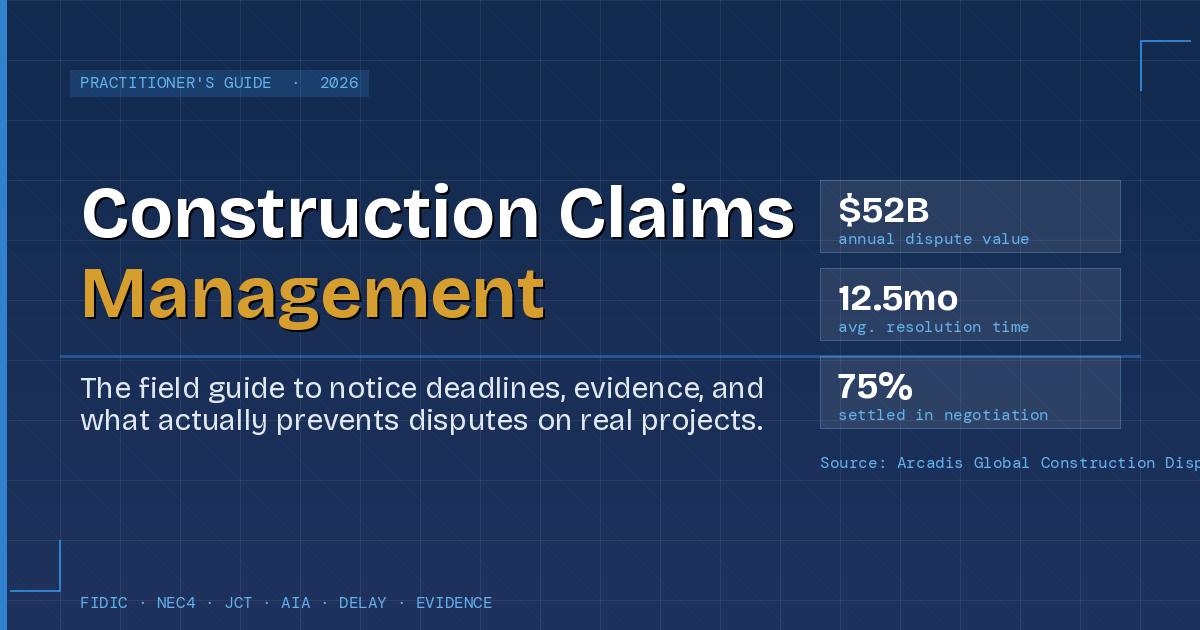
About 75% of formally submitted construction claims management disputes settle through negotiation. The Arcadis 2024 Global Construction Disputes Report puts North American formal dispute resolution at 12.5 months average once proceedings begin. Most people focus on the time cost when they hear that figure. The more significant cost, in my view, is management attention — effectively unavailable for anything else during that period. It’s a tax on ongoing projects that doesn’t appear in the dispute’s cost accounting.
When Negotiation Actually Works
Construction claims that don’t settle in negotiation fall into two categories. Either the evidence gap is too wide for any number to feel defensible, or the parties conduct the negotiation for form rather than function — building a record that the process happened, not actually trying to find a number both sides can accept. That distinction becomes apparent within the first meeting. Once both sides know what’s happening, negotiation becomes an expensive way to confirm that arbitration comes next.
Genuine negotiation requires both parties to honestly assess where they’re exposed. That’s psychologically difficult — it means acknowledging weaknesses in a case you spent months preparing. But it determines whether a realistic settlement range exists. Go in with only a strong-case view and the other side does the same, and you’ll talk past each other until someone blinks.
Some disputes are worth taking all the way. Bad faith. An indefensible offer. A principle that affects other projects. But treat escalation to formal proceedings as a deliberate choice, not a default when negotiation stalls.
| Area | What goes wrong | What works | Risk |
|---|---|---|---|
| Notice | Missing the deadline kills the claim | Track windows in every weekly meeting | Critical |
| Documentation | Gaps in site diaries weaken evidence | Daily records, no exceptions | Critical |
| Delay claims | Can’t prove critical path impact | Keep the as-built programme updated | High |
| Scope changes | No paper trail for verbal instructions | Log every RFI and site direction | High |
| Prevention | Poor coordination creates disputes early | Resolve design conflicts before construction | Preventable |
Construction Claims Prevention: What Actually Works
Design Coordination
Design coordination before the IFC issue offers the highest return of any prevention activity in construction claims management — and teams cut it most consistently when schedules tighten. High RFI volumes predict a claims-heavy project. Every RFI requiring a scope clarification is a potential constructive change claim in development. Resolving design conflicts during the design phase costs a fraction of litigating them as disputes during construction. The investment happens when no one watches the claims exposure, which is exactly why it gets cut.
Realistic Baselines
A programme built to win a bid rather than build a project creates EOT disputes and acceleration claims from the first progress review. The contractual record disconnects from operational reality immediately. Everyone knows the baseline is optimistic. Contract administration becomes theatre. That environment generates construction claims reliably. This isn’t a controversial opinion, but it hasn’t changed the way contracts get tendered.
Daily Documentation — the Non-Negotiable
Daily contemporaneous documentation, maintained without exception, is where the most expensive outcomes in construction claims management get determined by the most basic operational habits. Fifteen minutes a day. Every day, including quiet days. The quiet days establish the baseline against which teams later measure the disrupted period. A habit teams don’t establish at the project start doesn’t establish itself later — because later there’s always a reason it can wait until tomorrow.
One thing that rarely appears in construction claims prevention guidance: train the site team, not just the commercial team. The people physically present when trigger events occur create the contemporaneous record — or fail to. They need to know what constitutes a claim event, what the notice window is under this specific contract, and why the daily diary matters beyond their supervisor asking for it. That training takes a few hours at project start. What it prevents can be worth considerably more.

Victor Z Young is a Civil Engineer with 35 years of experience working alongside the executive team of various construction companies. Victor specializes in construction insurance, delay analysis, performance analysis and engineering. He holds a Doctor of Project Management from Northwestern University.



I like your tip about calculating the cost. That makes sense considering you want to stay within your budget. I’ll have to consider your tips so that I can stay ahead of schedule.
I like your tip about how pro tender is the preparation of concept design and contract documentation. I imagine builders have to focus heavily on this step so that they can have legal protection in the event of an accident or employees quitting. Good thing that construction litigators exist to help managers navigate the legal workings of a site.
Really a piece of great information to read. To renovate something is to alter the current appearance or structural integrity of the entity.
This article provides a comprehensive and insightful overview of the crucial concept of construction claims management. Good Work keep it up!
Irresistible! Thank you so much for this kind and good service.your services is better than better.
Great read. Thank you.
I am interested in construction claims management. I intend to be a specialist in the management of construction claims.
Ejike.