


I spent eight months as a project coordinator on a programme that had genuine executive support, a realistic budget, and a project manager who knew what he was doing. It still ran 14 weeks late. The reason wasn’t technical complexity or scope creep. It was that the procurement team’s priorities were set by the procurement director, who had no accountability for our schedule and no particular incentive to treat our milestones as his problem. The project manager could flag slippage. He couldn’t override a functional director. That’s what types of organizational structures in project management actually means in practice — not an org chart category, but who has the authority to make the call when priorities conflict.
Table of Contents
What Organizational Structure Actually Means for a Project Manager
The organizational structure a project sits inside shapes its execution in ways that most project plans never surface. Who actually controls the resources? Who holds the budget? When a team member’s project workload runs into something their line manager considers more urgent, who wins? These aren’t methodology questions. They’re structural ones — and the organizational structure in project management determines the answer, whether anyone has spelled it out or not.
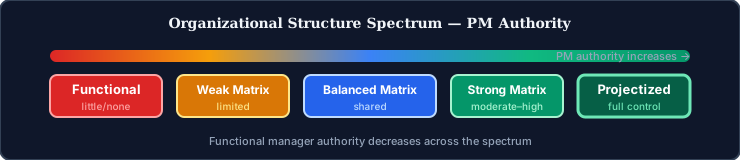
PMBOK puts organizational structure in the category of enterprise environmental factors — conditions the project manager inherits rather than controls. The consequence is that the same person, managing the same type of project using the same approach, can have radically different levels of authority depending on which structure they’re operating inside. In a functional structure: no direct budget control, no formal authority over team members, coordination through influence and escalation. In a projectized structure: owns the budget, leads the team, reports to a sponsor or board. The title might say “project manager” in both cases. What the title means in practice is almost entirely determined by the structure.
Functional Organizational Structure in Project Management
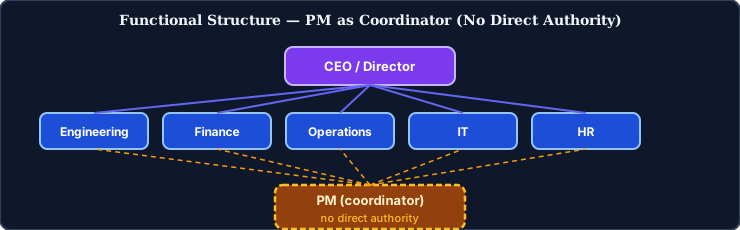
In a functional structure, people are grouped by what they do. Engineering together. Finance together. Operations, IT, HR — each in their own silo, each with a functional manager who controls headcount and sets priorities for the team. The performance review process belongs to that manager. So does the team member’s attention, when priorities conflict.
Projects happen inside or across these departments. No single person owns the project end-to-end with authority to match. The PM — often called a project coordinator or project lead in this environment — can plan, track and escalate. They can’t direct. If the engineering manager decides their team is being pulled to support a product launch, and that decision affects your project timeline, you have limited formal recourse. You can escalate. You can flag it to your sponsor. You can update the risk register. But you can’t override the functional manager’s decision, because that’s not where authority sits in this structure.
This is where the programme I mentioned at the outset went wrong — and it’s the defining weakness of the functional organizational structure in project management.The procurement director wasn’t obstructing the project. He was prioritising his own department’s workload in the way a functional manager does. The project manager had no structural leverage to change that — until a steering committee with cross-functional director membership was formed, which effectively created a temporary matrix layer over the functional structure. That workaround worked. Eventually. It also added three months of relationship-building before it was functional.
Where functional structure holds and where it doesn’t
A project that lives within one department has no particular problem with a functional structure. The team is already together. The reporting lines are already clear. An IT team implementing a system upgrade, a finance function running a process review — these work fine. The structure starts to fail when the project needs sustained, roughly equal contributions from multiple departments over a significant period. At that point there’s no structural mechanism for deciding whose priorities take precedence. Everything has to be escalated to whoever sits above both department heads, which is usually slow and often produces decisions that favour whoever escalated most recently rather than whoever had the stronger case.
Matrix Organizational Structure in Project Management: Weak, Balanced and Strong
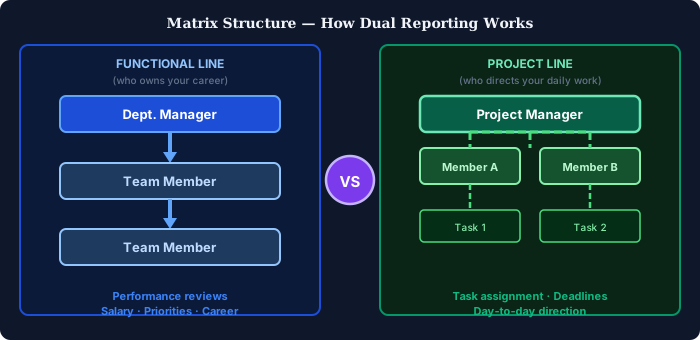
The matrix is an attempt to solve the functional structure’s central problem — the PM having no authority — without breaking up the functional departments that give the organisation its specialist depth. Resources stay in functional departments but get assigned to projects. The PM and the functional manager share authority. Or at least share the employee’s time — which in a weak matrix is often the only thing that’s actually shared.
Whether that sharing works depends on which type of matrix it is. Three types. PMBOK identifies them as weak, balanced and strong — and the names describe exactly where the balance of power sits.
Weak matrix
The functional manager still runs things. The PM is part-time or advisory — present at the coordination level but not directing anyone. When the PM and functional manager give conflicting signals, the team member does what the functional manager says. That’s where the performance review lives. A weak matrix is closer to a functional structure with a project coordination role grafted onto it than to any genuine sharing of authority, and most people who’ve worked inside one would describe it that way.
Balanced Matrix: The Organizational Structure Where Authority Is Shared in Project Management
Authority is split between the PM and functional managers — genuinely split, not nominally. Which creates a specific and recurring problem: when the two authorities disagree about what the team should be working on, someone has to resolve it. The balanced matrix needs clear escalation paths, a governance structure, and a steering group that will actually arbitrate rather than defer. Without these, the people doing the work end up managing upwards more than delivering. I’ve sat in rooms where a functional manager and a project manager each had a reasonable case for their priority taking precedence. Nobody wins that meeting cleanly. The work waits. For days, sometimes weeks.
Strong matrix
The PM has more authority than the functional manager over project resources. Budget allocation, task assignment, day-to-day direction — these sit with the PM during the project. The functional manager stays responsible for technical standards, professional development and performance review input, but while someone is assigned to the project, the PM leads.
This is the closest the matrix gets to a projectized environment. No permanent project division needed. It’s also the one that requires the most explicit authority definition upfront — if the functional manager hasn’t genuinely accepted that the PM holds priority during the project, the “strong” matrix reverts to a balanced or weak one in practice, regardless of what the org chart says.
Projectized Organizational Structure in Project Management
In a projectized structure, the PM runs things. Teams are assembled for the project, report to the PM directly, and have no functional manager competing for their attention. No dual reporting. No competing priorities from a line manager who wasn’t in the room when the project schedule was built. When the project ends, the team is reassigned or released.
Construction companies. Engineering consultancies. Management consulting firms. These tend to operate this way — they represent the projectized end of the types of organizational structures in project management spectrum. A civil engineering contractor running a motorway upgrade isn’t organised by functional department — it’s organised by contract. The programme manager has a team, a budget and a clear reporting line to the client and the board. The problems that occupy a PM in this environment are different from those in a functional structure: managing client relationships, delivery risk, subcontractor performance, programme interfaces. Not departmental politics. Not competing for a developer’s time against a maintenance backlog. Different problems. Different tools. Generally more tractable.
The structural weakness is simpler. It’s what happens between projects. Teams assembled for a specific project end when the project ends. If the organisation doesn’t have continuity of work, specialists are either held idle (expensive) or released (and have to be rehired for the next project). Knowledge accumulated on one project rarely transfers systematically to the next — there’s no permanent functional home carrying institutional memory, no department that owns lessons learned, no one whose job it is to make sure the next team doesn’t repeat the same mistakes that cost the last team three weeks in month four. Each team starts from scratch. Again.
Other Types of Organizational Structures in Project Management
Flat (horizontal) structure
Few management layers between staff and senior leadership. Fast decisions. Broad scope. But coordination complexity grows quickly as the organisation scales, and what works at 12 people usually doesn’t survive contact with 60. Common in startups and early-stage companies. Projects are often informal, PMs have wide authority but limited resources, and the biggest risk is that everyone is working on everything simultaneously with no clear prioritisation mechanism.
Divisional structure
Organisation divided by product line, geography or customer segment — each division has its own functional departments. A large multinational might have divisions for each region, each with their own engineering, finance and operations teams. Cross-divisional projects face the same structural problems as cross-departmental functional projects, scaled up and complicated by geographic distance, time zone differences and often different local cultures of authority and escalation. I’ve seen cross-divisional programmes where the divisional structure meant that what looked like a single project on the programme charter was effectively four separate projects. Separate budgets. Separate approval chains. Separate reporting lines. Held together by a programme manager whose actual authority over any of the four was limited to whatever informal influence he could build over 18 months.
Network structure
No permanent internal team. A central organisation coordinates with external partners, contractors and specialists. Common in media, fashion and technology. The PM’s authority extends only as far as the contract — you can’t direct a subcontractor to reprioritise the same way you’d direct an employee, and when a key subcontractor runs into capacity problems, there’s no internal pool to draw from. Replacing a subcontractor mid-project is a qualitatively different problem from reassigning an internal team member, particularly if the subcontractor holds specialist knowledge or client relationships that weren’t documented before they became unavailable.
Comparison: PM Authority Across Types of Organizational Structures in Project Management
| Structure | PM authority | Budget control | Team loyalty | Resource flexibility |
|---|---|---|---|---|
| Functional | Little or none | Functional manager | To functional manager | Low |
| Weak matrix | Limited | Functional manager | Primarily functional | Low–medium |
| Balanced matrix | Shared | Shared | Split | Medium |
| Strong matrix | Moderate–high | Project manager | Primarily project | Medium–high |
| Projectized | Full | Project manager | To project manager | High |
Matching Types of Organizational Structures in Project Management to Your Project
Organisations rarely choose a structure based on project needs. The structure usually already exists, and the projects happen inside it. That’s the more important thing to understand. Most of the time, you’re not designing the structure. You’re inheriting it. The relevant question isn’t “which structure is best?” but “what does this organizational structure in project management mean for how I manage this project?”
That said, when an organisation has flexibility — or when a specific programme is large enough to justify building a temporary structure around it — the match between project characteristics and structure type does matter.
Functional structures suit projects confined to a single specialism, short in duration, and low in cross-departmental dependency. Internal technology upgrades, process reviews within a single function, product development entirely within one engineering team.
Matrix structures suit organisations running multiple projects simultaneously using shared specialist resources. The matrix fails when the governance infrastructure isn’t built before the dual-authority arrangement goes live — escalation paths, resource allocation processes, steering groups with real decision-making authority. Most organisations implement the matrix first. Then they discover they needed the governance. The sequence should be the other way around. It rarely is.
Projectized structures suit large, complex, long-duration projects where delivery decisions have to be made quickly and the PM needs real authority to make them. Infrastructure programmes, major software products, consulting engagements, construction contracts. The tradeoff is cost — dedicated teams mean resources aren’t shared, and there’s idle capacity risk between project phases and between contracts.
Types of Organizational Structures in Project Management: PMP and CAPM Exam Context
The PMP and CAPM exams test organizational structure mostly through scenarios rather than straight definitions. A question describes a situation — limited PM authority, team members prioritising their functional manager’s workload — and asks you to identify the structure type, or predict what level of authority a PM would have in a named structure. Knowing what each structure type produces in practice is more useful than memorising the labels.
The exam focuses on the extremes and the gradient between them. Functional versus projectized is the core distinction. The three matrix variants — weak, balanced, strong — and what differentiates them in terms of PM authority. And one specific point that catches candidates out: the job title and the structural reality are not the same thing. Someone called “project manager” in a functional organisation may have none of the authority that title implies in a projectized one. The exam tests whether you understand what the structure actually produces, not just what each type is called.
For broader context on how organisational design affects delivery, the APM’s project management overview covers governance and structure in depth. For how organisational structure interacts with project governance in practice, see the articles on project life cycle phases and project risk management, which cover how decision-making authority and governance frameworks connect to the structural environment the project runs inside.

Laura McLaron is a highly skilled strategist whose 25 years of experience in optimizing businesses and inspiring individuals has transformed ActionX Consulting to one of the premier talent management and learning and training firms in the global marketplace.