


Cost classification is one of those topics that seems obvious until you’re sitting in front of a budget and trying to decide whether the project manager’s time is direct or indirect. Or whether the site welfare facilities on a construction project are overhead or a direct project cost. The distinction between direct costs and indirect costs matters for budgeting, cost control, contract pricing, and financial reporting — and it’s less clean in practice than the definitions suggest.
Table of Contents
Why Cost Classification Matters for Project Budgeting
Cost classification is the process of sorting costs into categories so they can be tracked, controlled, and reported consistently. In project management, the most fundamental classification is the distinction between direct costs and indirect costs. Getting this right matters for several reasons.
When building a baseline budget, a cost engineer or project manager needs to know which costs are directly attributable to project deliverables and which are shared across the organisation. Misclassifying direct costs as overhead (or vice versa) produces a budget that’s wrong in structure even if the total number looks plausible.
It matters for contract pricing too. Fixed-price contracts include direct costs plus a markup for overhead and profit. If the overhead rate is calculated on the wrong cost base — because some costs are misclassified — the pricing is systematically off. On projects with tight margins, that compounds over time.
Grant compliance is the third area where it bites. Many grant-funded projects have specific rules about what can be charged as a direct cost. Charging indirect costs directly — or vice versa — can create compliance problems. Some funding bodies require a formal indirect cost rate that must be agreed in advance.
Direct Costs: Definition and Examples
Direct costs are costs that can be unambiguously traced to a specific project, product, or deliverable. They are incurred because of that specific output. Remove the output and the cost disappears.
In a construction project: the concrete poured for a specific foundation is a direct cost of that foundation. The steel fabricated for a specific structural frame is a direct cost of that frame. The labour hours spent installing a specific piece of equipment are a direct cost of that installation.
The question to ask: would this cost exist if this specific deliverable didn’t exist? If no, it’s direct. If yes — the cost would still be there regardless — it’s indirect. That test works most of the time. The grey zone section below covers the cases where it doesn’t.
Direct cost examples
- Raw materials used in production or construction
- Labour directly engaged in producing the deliverable (site operatives, manufacturing workers, software developers assigned to a specific feature)
- Equipment hired specifically for the project
- Subcontractor costs for defined scope
- Travel costs directly incurred for project delivery
- Testing and inspection costs for specific deliverables
- Software licences purchased specifically for the project
On a software development project, a developer spending 80% of their time on a single product feature has 80% of their cost as a direct cost of that feature. The remaining 20% — spent in team meetings, training, or supporting other work — might be indirect. Whether that split is tracked and applied depends on the accounting system and contract requirements.
Indirect Costs: Definition and Examples
Indirect costs are costs that cannot be directly attributed to a single project or deliverable. They are necessary for the organisation to function and deliver its work, but they support multiple projects or activities simultaneously rather than one specific output.
Indirect costs are also called overhead. They include the shared infrastructure, management, and support functions that make project delivery possible but aren’t consumed by any single project.
Indirect cost examples
- Office rent and utilities
- Senior management and executive salaries (where not project-specific)
- Central HR, finance, and IT functions
- General marketing and business development
- Depreciation of shared equipment
- Insurance (where not project-specific)
- General training and development
- Legal and compliance functions
Indirect costs are typically recovered through an overhead rate — a percentage applied to direct costs or direct labour to distribute the shared costs across all work. An organisation with £2m of overhead and £8m of direct labour might apply a 25% overhead rate to all direct labour costs. How that rate is calculated, and how often it’s reviewed, varies considerably between organisations. On cost-reimbursable government contracts, the indirect cost rate is sometimes subject to audit and formal approval.
How Direct and Indirect Costs Split in a Project Budget
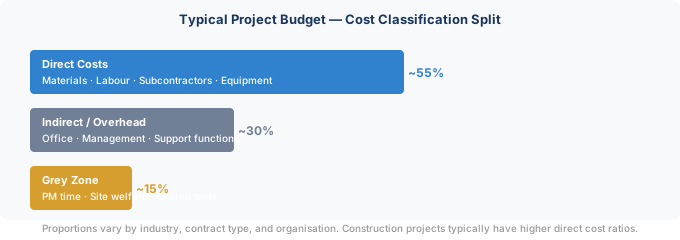
The visual below shows how a typical project budget breaks down between direct costs (attributable to specific deliverables), indirect costs (shared overhead), and the grey zone where classification depends on context.
Key Differences Between Direct and Indirect Costs
| Direct costs | Indirect costs | |
|---|---|---|
| Traceability | Directly traceable to one project or deliverable | Shared across multiple projects or the whole organisation |
| Relationship to output | Incurred because of this specific output | Incurred to support operations generally |
| Behaviour if project removed | Would not be incurred | Would still be incurred (may reduce over time) |
| Recovery method | Charged directly to project cost code | Allocated via overhead rate or cost absorption |
| Typical examples | Materials, direct labour, subcontractors | Office rent, management salaries, IT infrastructure |
| Pricing treatment | Included in direct cost estimate | Added as overhead % markup |
The Grey Zone: Costs That Are Both
The direct/indirect distinction sounds clear until you apply it to real projects. Several cost categories consistently cause classification disputes.
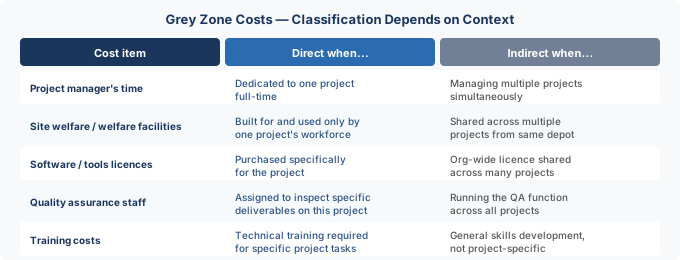
Project manager time is the one I see disputed most often. A PM dedicated full-time to one project — their salary is a direct cost of that project. A PM running three projects simultaneously — allocating their time becomes an accounting exercise, and the result (whether 33/33/33 or weighted by project size or complexity) is partly a convention rather than a reflection of actual time spent. It matters for cost-reimbursable contracts where the client is paying for direct costs; getting the allocation wrong creates billing disputes.
Semi-variable costs add another layer. Site insurance on a construction project might have a fixed premium plus a variable component based on contract value. The variable portion is arguably direct; the fixed portion is more like overhead. Whether anyone actually splits it that way depends on how much it matters to the budget and whether the contract requires it.
Direct and Indirect Costs in Project Management
In project management, the direct/indirect distinction shapes how project budgets are structured, how costs are reported to clients, and how overhead is recovered across the portfolio.
In the project budget
A typical project budget structure separates direct costs (materials, direct labour, subcontractors, project-specific equipment) from indirect costs (project management overhead, company overhead, profit). The indirect costs may be expressed as a percentage applied to the direct cost total — common in construction and engineering — or as a fixed allowance, or as separately budgeted line items.
The problem with expressing indirect costs purely as a percentage: if direct costs change (scope additions, price escalation, design changes), the indirect cost total changes proportionally even if the actual overhead hasn’t changed. A 5% overhead rate on a project that grows from £10m to £14m adds £200,000 of overhead budget that may not reflect any actual increase in overhead cost. Project managers need to understand whether their overhead allocation is a cost recovery mechanism or a genuine estimate of overhead expenditure.
Other cost classification dimensions
Direct vs indirect isn’t the only split that matters. Fixed vs variable is often more useful for forecasting: fixed costs (site establishment, management salaries) don’t change with output volume; variable costs (materials, labour hours) do. When a project overruns in duration, it’s usually the fixed costs that compound — the weekly overhead keeps running even when productivity has dropped.
Controllable vs uncontrollable is useful for cost accountability. A project manager can influence subcontractor productivity and material waste. They can’t influence the allocated overhead rate that head office applies. Mixing them together in a single variance report obscures what’s actually within the PM’s control — and makes it harder to have a useful conversation about performance. For how cost classification connects to the broader budgeting process, see the baseline budget article.
Direct and indirect costs: a worked example
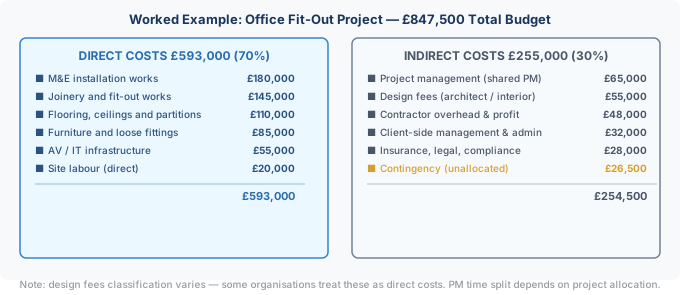
In this example, design fees sit in indirect — but on a design-and-build contract where the architect is engaged specifically for this project, they’d usually be direct. I’ve seen this classified both ways on similar projects by different cost engineers, both with defensible reasoning. The classification that matters is the one agreed upfront and applied consistently. Changing the classification mid-project — when the budget is under pressure and reclassifying something creates more headroom — is the version that causes problems.

Vice President, İntelligent Design & Consultancy Ltd
Over 12 years of global & rich experience in Portfolio & Program Delivery Management in leading & managing IT Governance, PMO, IT Portfolio/Program, IT Products, IT service delivery management, Budget Management, and more.



This is a great post! I have been trying to get my head around the different cost types and how to classify them for my next project. Thanks for the help!
This blog post does a fantastic job of clarifying the differences between direct and indirect costs! The examples really helped me understand how to classify them for my own budget. I appreciate the clear explanations and practical insights!
This post really helped clarify the difference between direct and indirect costs for me! The examples provided made it easy to understand how these classifications impact budgeting and financial decision-making. Thanks for the insightful breakdown!