


The best risk register I ever worked with was on a water network programme in West Yorkshire — around £60m, pipeline replacement across three district zones, 14-month delivery window. The risk owner column had names. The response column had specific actions with completion dates. The PM reviewed it every two weeks and challenged owners who hadn’t moved. That programme completed three weeks early. The worst was a hospital extension project where the risk register was a 74-row spreadsheet last meaningfully updated at month two of an 18-month contract. By the time a significant ground condition risk materialised in month nine, nobody could remember whether it had been on the register or not. It hadn’t. The risk management process in project management is not complicated — identify, analyse, respond, monitor, repeat. The difference between those two projects came down to one thing: whether the register was a management tool or a compliance document, and the two things produce completely different outcomes.
Table of Contents
The Risk Management Process in Project Management: Five Processes
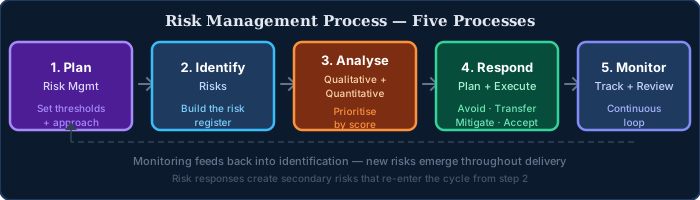
PMBOK breaks the risk management process in project management into five processes: Plan Risk Management, Identify Risks, Qualitative and Quantitative Risk Analysis, Plan Risk Responses, and Monitor Risks. They’re presented sequentially in the Guide. In delivery they overlap constantly. You’re identifying new risks while implementing responses to existing ones. A risk that materialises in month six often creates secondary risks that weren’t foreseeable at planning — those go straight into identification and analysis without waiting for the next formal review cycle.
Before You Start: Why Thresholds Matter More Than Documents
The first step in the risk management process in project management — Plan Risk Management — answers one question before the project starts managing risks: how are we going to do this? What scales do we use for probability and impact? What risk score triggers escalation? Who reviews the register and how often? On a large infrastructure programme, the output is a formal Risk Management Plan that gets baselined like any other project document. On a three-month internal project, it might be a page in the PID. The length doesn’t matter. What matters is that the team has agreed on thresholds before they start assessing risks — because without agreed thresholds, a risk one person rates as High another rates as Medium, and the prioritisation becomes noise.
The most important output of this process is agreement on risk thresholds — what level of risk is acceptable without escalation? What triggers a formal risk response? Different organisations and different stakeholders have completely different risk tolerances. A risk with a £50,000 cost impact might be below the radar for a £500m programme but be existential for a £200k contract. Without agreeing on thresholds upfront, risk assessment scores are meaningless because everyone applies different scales.
I’ve sat through risk review meetings where the project manager and the client’s representative were looking at the same risk register and drawing opposite conclusions about whether the risks were under control — not because their information was different, but because their risk thresholds were different and nobody had aligned them at the start. That’s the planning failure Plan Risk Management exists to prevent.
Finding Risks: What Workshops Miss and Interviews Catch
Identify Risks is where the risk management process in project management becomes concrete — documenting all foreseeable risks and opportunities that might affect the project. The output is the risk register — a log of all identified risks, each with a description, category, potential cause, and initial assessment.
The techniques matter. A brainstorm session with the project team produces a useful but incomplete list — the risks people are already worried about. It misses the risks nobody has thought of yet. A structured approach using prompt lists (technical risks, external risks, organisational risks, project management risks) surfaces a broader range. Historical risk data from similar previous projects is the most valuable input — if a risk occurred on the last three contracts of this type, it will likely appear on this one. Documenting that explicitly and assigning a response from day one is worth more than the entire qualitative risk analysis exercise on a risk nobody had flagged.
Risk Identification Techniques in the Project Risk Management Process
Interviews with subject matter experts surface risks that don’t appear in team workshops, because experts know where the bodies are buried in their domain. The site manager knows that the ground conditions in that area are typically variable regardless of what the investigation report says. The procurement lead knows that this particular supplier has had quality problems on similar contracts. These risks live in individuals’ heads, not in any document — structured interviews are the only way to extract them.
Assumptions analysis is underused. Every project plan contains implicit assumptions — that the client will provide information on time, that the design will be sufficiently developed before procurement, that regulatory approvals will follow the standard timeline. Each assumption is a potential risk. If the assumption is wrong, what happens? Converting assumptions to risks makes the register more complete and surfaces dependencies that the schedule may not capture.
Analysing Risks: Scoring, Prioritising and When Numbers Lie
Risk analysis prioritises the risk register. Not every identified risk warrants the same level of attention — qualitative analysis uses probability and impact scales to rank risks, and quantitative analysis assigns monetary or schedule values to the highest-priority risks.
Qualitative Risk Analysis: How the Risk Management Process Prioritises
Qualitative analysis is the probability-impact matrix. Each risk gets a probability rating (typically Very Low / Low / Medium / High / Very High) and an impact rating across one or more dimensions (cost, schedule, quality, reputational). Multiply probability by impact and you get a risk score. High scores get most attention. This sounds straightforward. The problem is consistency — different team members apply different scales to the same risk, which means the prioritisation is unreliable unless the scales are defined and calibrated in advance.
On a commercial office fit-out programme I was involved with, the risk register had 47 risks. The top ten by risk score consumed about 80% of the risk management effort. Three of those top ten were medium-probability, high-impact risks that everyone knew about and had informal responses for. Four were low-probability, catastrophic-impact risks that nobody had thought through responses to, because the score was high but the probability of actually needing to do anything seemed low. The remaining three were borderline cases where the probability rating was debated in every review meeting. Understanding which category each high-score risk falls into shapes how you allocate response planning effort.
Quantitative risk analysis
Quantitative analysis tries to put actual numbers on the risk picture — cost impacts, probabilities, and what the combined effect of all the risks looks like across the project’s cost or schedule. The main tools are EMV calculations and Monte Carlo simulation, which runs thousands of iterations of the risk model to produce a probability distribution rather than a single point estimate. This is the basis for contingency reserve calculations — how much budget should be held to cover identified risks?
Quantitative analysis requires better data than most projects have. The EMV calculation is only as reliable as the cost impact estimates, which are usually rough on risks that haven’t materialised yet. Monte Carlo simulation requires probability distributions rather than point estimates, which requires experienced risk practitioners and meaningful historical data. For most projects, the priority ordering from qualitative analysis is sufficient. Quantitative analysis earns its cost on large capital programmes where the contingency budget is material and a defensible calculation is required for board or funder approval.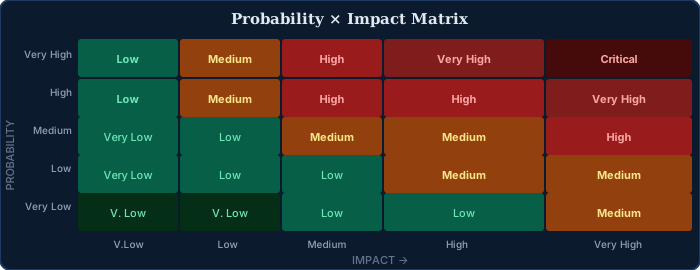
Responding to Risks: Four Strategies and Their Real-World Catches
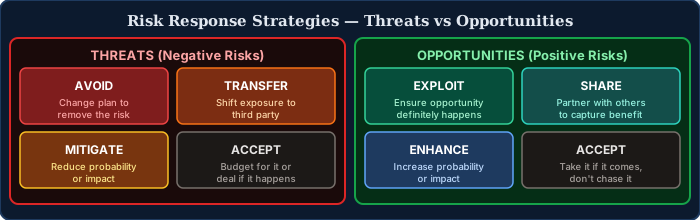
Plan Risk Responses identifies what the project will do about each significant risk. PMBOK identifies four response strategies for threats and four for opportunities.
Response strategies for threats (negative risks)
Avoid means changing the plan to remove the risk entirely — switching from a novel technology to a proven one, descoping a high-risk element, extending the timeline to eliminate a critical path that was too compressed to be realistic. Avoidance is the most effective response when it’s available. It’s also often the most politically difficult, because it usually means telling someone their preferred approach isn’t viable.
Transfer moves the financial exposure to a third party — insurance, fixed-price contracts, performance bonds. The risk doesn’t disappear. I’ve seen this play out on a civils contract where ground risk was transferred to the groundworks subcontractor via a fixed-price package. The subcontractor priced it aggressively, the risk materialised, and by month four they were struggling financially. The risk was “transferred.” The problem was back on the main contractor’s desk by month five, twice as large, with a subcontractor in financial distress and no fallback plan. Transfer is often cleaner on paper than it ends up being.
Mitigate is what most response planning actually produces — actions to reduce probability or impact to a tolerable level. Additional ground investigation before committing to foundation design. Pilot testing before full-scale deployment. Dual sourcing for critical materials. Mitigation actions need to be specific, owned, costed and tracked. “Maintain close communication with the supplier” is not a mitigation action. “Weekly call with supplier procurement lead with escalation to commercial director if lead time exceeds 12 weeks” is.
Accept is a decision, not an absence of decision. Active acceptance means allocating contingency reserve to the risk and defining the trigger for drawing on it. Passive acceptance means noting the risk and doing nothing unless it materialises. Passive acceptance is only appropriate when the cost of any other response exceeds the expected cost of the risk. Using it as a default for risks the team doesn’t want to think about is how risk registers stop being useful.
Response strategies for opportunities (positive risks)
In practice, opportunity management is where risk plans go to die. Every Risk Management Plan I’ve seen in the last decade has had an “opportunities” section. Most risk registers have zero entries under it. The instinct is to treat risk management as a defensive exercise — protect the baseline, avoid the bad outcomes. But a well-structured opportunity on a construction programme can bring forward a milestone by weeks if it’s identified early enough and someone is actually given authority to exploit it. An opportunity to accelerate a programme milestone by overlapping activities — if it’s assessed, planned and resourced — can create real schedule benefit. Exploit, Share, Enhance and Accept are the four opportunity strategies, mirroring the threat strategies. In practice, Enhance (increasing the probability or impact of a positive event) is the most useful — finding ways to make good outcomes more likely rather than just hoping for them.
Monitoring Risks: The Step the Risk Management Process in Project Management Describes Last and Projects Abandon First
Monitor Risks is the process most risk frameworks describe last and most projects abandon first. Track identified risks, spot new ones, check whether responses are actually working, and keep risk management embedded in governance rather than boxed off as a planning-phase exercise.
The minimum viable version: a structured risk review at every progress meeting, with an owner responsible for each risk who reports on status rather than just confirming the rating hasn’t changed. Risk registers that get updated by copying last month’s register and changing the date aren’t being monitored — they’re being maintained for compliance. The difference is whether the risk owner has actually checked whether the risk is closer or further from materialising, whether the response is working, and whether any new risks have emerged since the last review.
Secondary risks — risks created by a risk response — are frequently missed. Transferring a risk to a subcontractor via a fixed-price contract introduces a counterparty risk: what if the subcontractor can’t absorb the cost and goes into administration? The transfer worked, but created a new risk. Monitoring should track secondary risks as explicitly as primary ones.
The Project Risk Management Terms That Actually Come Up
The project risk management terms below come up in every risk review, every risk register, and on the PMP exam. Some are more ambiguous in practice than their definitions suggest — the notes column is where the textbook version and the real version diverge.
| Term | Definition | Practical note |
|---|---|---|
| Risk | An uncertain event or condition that, if it occurs, has a positive or negative effect on project objectives | Includes both threats and opportunities — a definition many practitioners forget |
| Threat | A risk with a negative impact on project objectives | The “risk” in everyday project conversations |
| Opportunity | A risk with a positive impact on project objectives | Systematically underused; same process applies as threats |
| Risk register | The document capturing all identified risks, their analysis, owners and responses | Living document — should change with every review cycle |
| Probability | The likelihood of a risk occurring, expressed as a percentage or scale | Estimated, not calculated — consistency of scale matters more than precision |
| Impact | The consequence if the risk occurs, measured across cost, schedule, quality and/or other dimensions | Multi-dimensional; a risk can be low cost impact but high reputational impact |
| Risk score | Probability × Impact, used to prioritise risks | Only meaningful if scales are consistently applied across the team |
| Risk owner | The person accountable for managing a specific risk and its response | Should have authority to take the actions required, not just report status |
| Residual risk | The risk remaining after responses have been implemented | Residual risk, not zero risk — acceptance threshold should be defined |
| Secondary risk | A new risk created by a risk response | Often overlooked; transfer and mitigation responses routinely generate secondary risks |
| Risk appetite | The amount and type of risk an organisation is willing to accept to achieve its objectives | Set at organisational level; influences project-level thresholds |
| Risk tolerance | The acceptable deviation from the risk appetite threshold | Operationalises risk appetite into specific thresholds |
| Contingency reserve | Budget held to cover identified risks if they materialise | Calculated from the risk register; PM authority to release |
| Management reserve | Budget held for unforeseen risks not in the risk register | Outside the cost baseline; requires sponsor approval to access |
| EMV | Expected Monetary Value — probability × cost impact, summed across risks | Used to calculate contingency reserve; underestimates worst-case |
| Risk trigger | A condition or event that indicates a risk is about to materialise | Defines when to activate the risk response; should be specific and measurable |
What Makes a Risk Register Actually Useful
Most risk registers have the same structure everywhere: risk ID, description, probability, impact, score, owner, response, status. That structure is fine. The problem is almost never the format.
The problems are consistent across project types and sectors. Risk descriptions are too vague — “procurement delay” could mean anything from a one-week slippage to the complete failure of the supply chain, and a risk described that broadly can’t be meaningfully assessed or responded to. Risk owners are assigned but not given authority — someone is listed as “owner” of a risk that requires decisions from two levels above them, so the ownership is nominal. Response plans describe intention rather than action — “monitor closely” is not a risk response. Monitoring is part of the process; a response is a specific planned action that changes the risk’s probability or impact.
The most useful change I’ve seen on a risk register was simple: adding a “next action” column with a name and a date. Not a response description — a specific next action that the risk owner had committed to taking before the next review meeting. That one column changed the register from a status document to a task management tool. Risk owners started showing up to reviews having actually done something about their risks, because there was a public record of what they’d committed to.
If the part of risk management that keeps tripping you up is the money side — specifically what goes in contingency reserve versus what goes in management reserve, and who controls which — that distinction is covered in detail in the contingency reserve vs management reserve article. It’s the question that comes up most often in practice and the one most frequently answered wrong. The project life cycle phases article covers when each risk process is most active — risk identification front-loaded, monitoring throughout. For exam purposes, the PMI PMBOK Guide and PMI Risk Practice Standard are the references to work from.

Francois Simosa is the head of training for the Gragados Training Associates, which provides special project management and risk management training programs.