


On a retail fit-out project I worked on in Birmingham — about a £1.8m contract, 14-week programme — the client’s facilities manager started attending site visits. Friendly, engaged, full of small suggestions. “Could we shift that partition six inches?” “The lighting in the back office — could we add two more downlights?” Each request was minor. Each was granted without paperwork. By week eight, we’d absorbed eleven changes that nobody had priced, the programme had drifted by three weeks, and the main contractor was carrying cost overruns they hadn’t budgeted for. That was scope creep and gold plating happening simultaneously — scope creep from the client’s incremental additions, gold plating from the site team’s habit of fixing things the client hadn’t asked about. Both cost money. Neither showed up on any change control register.
Table of Contents
Scope Creep and Gold Plating: What Each One Actually Is
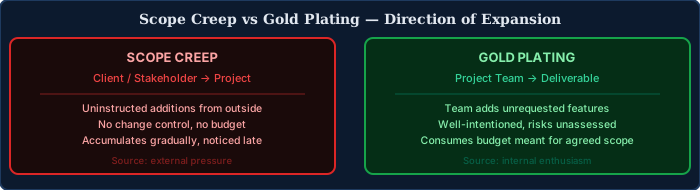
Scope creep isn’t usually one big addition. It’s eleven small ones over eight weeks. Each request arrives informally, each gets absorbed without paperwork, and by the time anyone notices the cumulative weight, the project is carrying work that was never priced. The scope grows; the budget doesn’t. That’s the core of it. Work added without going through change control, without any corresponding adjustment to time or cost, until the gap between what was agreed and what’s being delivered has become significant.
Gold plating is the same failure from the opposite direction. The client asked for a functional reporting module. The development team built the module plus a dashboard they thought would be useful, plus an export function they added “while we were in the code anyway.” Nobody asked for those additions. Nobody priced them. The team made a unilateral decision that the product should be better than specified — and that decision consumed budget and programme that belonged to the agreed scope.
Direction is the one distinguishing factor. Scope creep comes from outside — clients, stakeholders, the facilities manager who attends site visits and starts making suggestions. Gold plating comes from inside — the developer who improves what wasn’t asked to be improved, the finishing contractor who upgrades a specification because they thought it looked cheap. Different sources. Different governance responses. But both damage the project in ways that are entirely avoidable.
Scope Creep in Project Management: Where It Comes From
Scope creep rarely arrives as a single dramatic change. It comes in small installments — a request here, a tweak there — each of which seems too minor to push back on. By the time the cumulative impact is visible, the project is already significantly over its original scope.
The client who gets more comfortable
The most common source of scope creep in project management is a client who becomes more engaged as the project progresses. At contract stage, the scope was abstract — a written specification, a set of drawings, a statement of requirements. As the project develops and the client can see what they’re getting, they start to see what they want adjusted. Each adjustment is reasonable in isolation. None of them was priced. On the Birmingham retail project I described, the facilities manager wasn’t trying to expand scope without paying for it — she genuinely believed she was asking for “small things.” She probably was. Eleven small things over eight weeks, without any of them going through change control, is not small.
Stakeholders who weren’t in the room
Scope creep from stakeholders who weren’t consulted during scope definition is arguably more damaging than client-driven creep, because it’s harder to anticipate. The end users who will actually use the system weren’t involved in writing the requirements. The operations team who will maintain the building weren’t consulted on the design. When these stakeholders engage with the project — often after work has started — they identify requirements that were missing from the original specification. Some of those requirements are legitimate gaps that need addressing. Some are preferences that go beyond what was agreed. Distinguishing between them is a scope management judgment call that the PM needs to make explicitly, not by default.
The PM who absorbs rather than documents
Some scope creep happens because the PM is reluctant to push back on client requests. The relationship is good. The client is important. The change seems minor. Saying “that needs to go through change control” feels like making a fuss over nothing. So the PM absorbs the change informally, it gets delivered, and nobody documents it. Then three more like it follow. Then the project is over budget and the PM is explaining a cost overrun to a sponsor who has no idea how it happened, because none of the individual decisions were significant enough to flag.
This is a governance failure, but it’s also a confidence failure. Implementing change control consistently — even on changes that seem small — requires the PM to have conversations that feel uncomfortable in the moment. “I need to raise a change request for that” is not an accusation. It’s a professional process. The PMs who handle scope creep best are the ones who apply change control with enough consistency that it becomes expected, rather than applying it selectively and unpredictably.
Poorly defined scope at the start
The most preventable source of scope creep is a scope that was never well defined in the first place. If the project brief says “deliver a refurbished open-plan office space” without specifying finishes, furniture standard, M+E specification or IT provision, there’s no clear boundary between what’s included and what isn’t. Every subsequent disagreement about scope becomes a negotiation rather than a reference to an agreed document. Scope creep fills the gaps that scope definition left open.
Scope Creep and Gold Plating: Why Teams Gold Plate in Project Management
Gold plating is almost always motivated by good intentions. The team is trying to deliver something better than was specified. That impulse — to go beyond the brief, to delight the client — is not inherently wrong. Managed appropriately, it can produce excellent outcomes. Unmanaged, it’s a scope and risk problem.
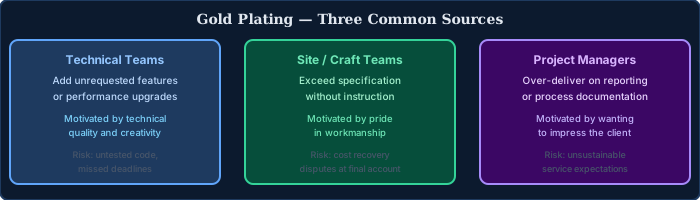
The developer who adds features
Software development is where gold plating in project management comes up most often, and for good reason. Developers are often technically creative and genuinely interested in producing good software. When the specified solution seems limited or inelegant, the instinct is to improve it. The dashboard that wasn’t asked for but seemed like an obvious addition. The API endpoint added “while we were in the code anyway.” The performance optimisation that took three days because the developer felt the specified response time was too slow for a good user experience. Each of these additions might improve the product. Each consumes time and introduces untested code. Each moves the project away from delivering what was agreed and toward delivering what the team thought would be better.
The contractor who “fixes” things
In construction, gold plating project management discussions tend to focus on workmanship decisions that exceed specification. A finishing trade decides the specified paint finish is inadequate for the space and upgrades it. An electrician re-routes cabling in a way that’s neater than the drawing but takes twice as long. A joiner adds detail to a built-in unit that wasn’t in the design. These decisions are made by people who take pride in their work and want to produce a good result. They’re also unilateral scope changes that consume programme and budget without authorisation.
The problem is compounded because gold plating in construction often goes unnoticed until the final account. The client doesn’t know the specified finish was upgraded. The contractor doesn’t know how to cost the change. The quantity surveyor has no record of it. At final account, the contractor tries to recover the cost of improvements the client didn’t ask for and didn’t know about — and the conversation is unpleasant for everyone.
The PM who wants to impress
Gold plating project management at the PM level looks like over-delivery on reporting — detailed weekly dashboards when the client asked for monthly summaries, elaborate risk registers for a low-risk project, comprehensive lessons learned documentation for a two-week engagement. These additions are well-intentioned and may be genuinely useful. They also consume the PM’s time, which comes from somewhere, and they set an expectation for the level of service that the contract doesn’t price for.
Scope Creep and Gold Plating: A Direct Comparison
| Scope Creep | Gold Plating | |
|---|---|---|
| Origin | External — client, stakeholders | Internal — project team |
| Intent | Client wants more; often not aware of impact | Team wants to deliver better; well-intentioned |
| Visibility | Often visible to client, invisible to sponsor | Often invisible to everyone until delivery |
| Change control | Bypassed — additions not formally approved | Not applicable — team acts unilaterally |
| Cost impact | Usually borne by contractor/PM without recovery | Consumed from project budget silently |
| Schedule impact | Programme slippage, often attributed to other causes | Delayed delivery of agreed scope |
| Risk impact | Unanticipated scope increases risk exposure | Unrequested features introduce untested risk |
| Client awareness | Usually aware — they requested it | Often unaware — or aware after the fact |
| PMI position | Scope management failure to prevent | PM should not gold plate, even if “better” |
The Damage Scope Creep and Gold Plating Do — and Why They’re Different
Scope creep and gold plating both erode project performance. But they erode it in different ways, and conflating them leads to the wrong responses.
What scope creep actually costs
Scope creep costs the delivering party — usually the contractor or PM — in time and money that they absorb without formal recognition. It also tends to generate client expectations that are higher than the contract supports. On the Birmingham retail project, by the time we reached practical completion, the client expected a level of finish and completeness that reflected eleven unpriced changes. When some of those changes hadn’t been fully delivered — because they’d been absorbed informally and some fell through the cracks — the client was disappointed. The contractor was aggrieved. The relationship had deteriorated over three weeks of slippage and a disputed final account.
Scope creep also damages future relationships. A client who has successfully added scope informally on one project will attempt the same approach on the next. A PM who absorbs scope changes without raising them trains the client to expect that behaviour. The conversation that felt uncomfortable in week three — “I need to raise a change request for that” — is much easier than the conversation in week twelve about why the project is over budget and behind programme.
What gold plating actually costs
Gold plating costs in three specific ways. First, it consumes budget and programme that was allocated to agreed scope. If the development team spends three days on a dashboard nobody asked for, those three days came from somewhere — either from planned scope that doesn’t get delivered, or from contingency that was meant for risk events. Second, gold plated features are typically the least tested, because they weren’t in the test plan. They introduce risk without the risk assessment that would have accompanied a formal scope addition. Third, clients who discover gold plating after the fact are sometimes not grateful. They’re concerned about what else the team did that wasn’t asked for. The trust damage from discovering unilateral decisions, even well-intentioned ones, can exceed the value of the added feature.
How to Prevent Scope Creep in Project Management
Start with a tight scope definition
The work that comes back to bite you is almost always work that wasn’t explicitly excluded. A scope of work that’s clear about inclusions but silent on exclusions will generate scope creep — every gap will be filled by the client’s assumption of what’s included, not by yours. I’ve reviewed final accounts where the disputed items traced back to a single ambiguous line in the original specification. A well-written scope statement defines inclusions explicitly and states significant exclusions explicitly. “Interior fit-out including raised floors, suspended ceilings, partitions and M+E services” leaves the furniture question open. “Interior fit-out including raised floors, suspended ceilings, partitions and M+E services. Furniture, loose fittings and IT equipment excluded” doesn’t.
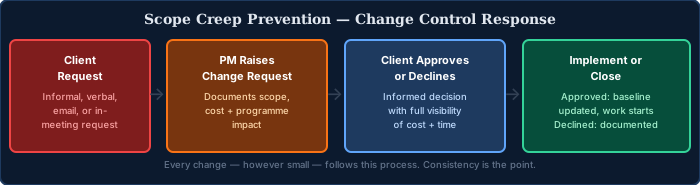
Implement change control from day one
Change control needs to be established and communicated before the first request arrives, not in response to the first request arriving. A change control process introduced mid-project, after informal changes have already been absorbed, is immediately seen as a retrospective attempt to charge for things that were already done. The client resists it. The PM is in a weaker position than if the process had been clear from the start.
The change control communication should happen at project kick-off: “Any changes to scope will be managed through our change control process. When a change request is raised, we’ll assess the cost and programme impact and bring it to you for approval before proceeding. Minor requests will be assessed and responded to within X days.” This framing makes change control sound like a service — fast, responsive, fair — rather than an obstacle.
Say “yes, and here’s what that means” rather than “no”
The framing that works — at least in my experience — is to position change control as part of the service rather than an obstacle to it. “That’s a good idea, I’ll raise a change request so we can get the cost and time impact to you quickly and you can decide whether to proceed.” That’s a different conversation to “no” or to silently absorbing the change and hoping it doesn’t surface at final account. It takes a bit of practice to say it naturally. The first few times it feels like you’re making a fuss. After a while it just becomes how you run the job.
How to Prevent Gold Plating in Project Management
Define “done” explicitly
Gold plating often happens in the space between “technically complete” and “actually done.” If the definition of done for a work package is clear — specific acceptance criteria, a verifiable standard, an explicit specification — there’s no room for a team member to decide that “done” includes additional features. A definition of done that says “functional reporting module delivering outputs specified in Appendix A of the requirements document” leaves no ambiguity about whether additional export formats are included. One that says “working reporting module” invites interpretation.
Manage the team’s improvement impulse without suppressing it
The instinct that produces gold plating — wanting to deliver something better than minimum — isn’t a problem in itself. The problem is the unilateral decision. A developer who identifies a genuine improvement and raises it with the PM, who raises it with the client, is doing exactly the right thing. A developer who identifies the same improvement and builds it without telling anyone has made a scope decision that wasn’t theirs to make. One of those outcomes occasionally produces a grateful client. The other produces untested code and a budget that went somewhere nobody noticed.
Track effort against agreed scope
Gold plating is most easily detected when actual effort is tracked against planned effort at work package level. If a development task was planned for three days and has consumed five, the question should be asked immediately: what’s the additional two days covering? If the answer is features that weren’t in the specification, that’s a gold plating conversation. If the answer is that the original estimate was wrong, that’s a different conversation. Either way, it should be had explicitly rather than discovered at the end when the project is over budget.
Change Control: The Defence Against Scope Creep and Gold Plating
Change control is the mechanism that makes scope management possible. It applies to both scope creep and gold plating — though the direction is different. For scope creep, change control provides the process that converts informal additions into formal, costed, authorised changes. For gold plating, change control provides the governance check that requires team members to get authorisation before implementing additions to agreed scope.
In practice, change control processes fail in predictable ways. They’re too slow — a two-week turnaround on a change request in a 12-week programme is useless. They’re applied selectively — used for large changes, bypassed for small ones, which is exactly backwards. Or they’re complex enough that people route around them informally. The process that actually works is simple, fast, and applied consistently to everything above a stated threshold. And crucially: every change request gets documented regardless of outcome. Approved or declined, it creates a record. That record is what protects the PM when someone disputes the final account six months later and asks why the project cost what it did.
The threshold question — what’s minor enough to implement without a change request — is one most project managers get wrong by setting too high. The temptation is to avoid “bureaucracy” for small changes. But the changes that accumulate into significant scope creep are precisely the ones that seemed too small to bother with. A threshold of zero — everything goes through change control, no exceptions — is administratively burdensome but produces the cleanest project governance. A threshold based on cost or programme impact (anything under £500 or two hours is implemented without a formal request) is more practical and will usually work, provided the threshold is stated explicitly and applied consistently. For more on how change control connects to baseline management, see the articles on project life cycle phases and project risk management.
Scope Creep and Gold Plating in the PMP Exam
The exam questions on this topic are scenario-based — here’s a situation, here’s what the PM did, was it right? Most of the scenarios are reasonably clear once you know the framework: identify whether the source is external (scope creep) or internal (gold plating), and identify whether change control was applied.
Key points for exam purposes. Scope creep is always a problem to be managed through change control — even when the client is happy with the additions. PMI’s position is that changes must go through formal change control regardless of how minor they seem. Gold plating is always wrong in PMI’s framework — even if the additional features are genuinely better than what was specified, the PM should not gold plate, because the client’s agreed scope is the standard, not the team’s judgment about what would be better. This is a position that some practitioners disagree with in practice — there are circumstances where exceeding specification is strategically sensible — but for exam purposes, gold plating is a PM failure to be avoided.
The exam also tests whether you can distinguish between the two. A scenario where a team member adds an unasked-for feature is gold plating, not scope creep. A scenario where a client informally requests an addition that the PM delivers without a change request is scope creep, not gold plating. The source — external versus internal — is the distinguishing factor. For related scope management concepts, see the work breakdown structure article, which covers how scope is decomposed and controlled, and the risk management process article — uncontrolled scope is one of the most reliable sources of project risk. The PMI PMBOK Guide covers scope management in full, including the Validate Scope and Control Scope processes.

A dedicated Career Coach, Agile Trainer and certified Senior Portfolio and Project Management Professional and writer holding a bachelor’s degree in Structural Engineering and over 20 years of professional experience in Professional Development / Career Coaching, Portfolio/Program/Project Management, Construction Management, and Business Development. She is the Content Manager of ProjectCubicle.